Four technologies at a glance
| Technology | How the ink is fixed | Prints on | Best for | Limits |
|---|---|---|---|---|
| Eco-solvent | The ink bonds into solvent-compatible media and is dried by heaters in the printer | Self-adhesive vinyl, frontlit and backlit banner, mesh and paper, from the roll | Vehicle wraps, decals, banners and posters | Roll media only; prints need several hours to a day to dry before laminating; the printing room needs ventilation |
| UV | UV light cures the ink on the surface the moment it is printed | Rigid boards, objects and roll media, coated or uncoated | Rigid signs, objects and personalisation; roll work that must be finished the same day | The cured ink is stiffer, so deep curves on wraps are better done in eco-solvent; glass and metal can need a primer |
| DTF | The design is printed with white on PET film, coated with adhesive powder and cured, then heat-pressed onto fabric | Garments and textiles in cotton, polyester and blends, light or dark | T-shirts, hoodies, workwear and bags in mixed, short runs | Textiles only; every transfer goes through a heat press |
| UV DTF | A cured UV sticker is printed on transfer film and laid on the item by hand | Glass, metal, plastic and wood, including curved and uneven items | Bottles, tumblers, mugs, packaging and promotional items | Not for fabrics that stretch; one extra application step per item |
Which technology for your work
| What you print | Technology | Why | Our printers |
|---|---|---|---|
| Vehicle wraps, decals and window graphics | Eco-solvent | The ink stays flexible on vinyl and stretches with the film over curves and rivets | UD-16R2CL, UD-18R2CL, UD-1800CN |
| Banners and posters in long runs | Eco-solvent or UV | Both print banner well: eco-solvent is the established choice, UV removes the drying time | UD-1800CN, UD-3200BE; UD-18R2LU, UD-3200BEW |
| Same-day roll jobs, including backlit | UV | Prints come off cured and can be cut, laminated or installed at once | UD-18R2LU, UD-3200BEW, Flora Xtra roll-to-roll |
| Rigid boards, signs and objects | UV flatbed | In our range, only UV prints directly on boards and objects | See our UV printer guide |
| Rigid boards and rolls, both every week | UV hybrid | One machine prints panels and roll graphics | See our UV printer guide |
| T-shirts, hoodies and textiles | DTF | Transfers work on cotton, polyester and blends, light or dark | DTF-Z600 Pro Max with the YXD-HA406 heat press |
| Stickers for bottles, mugs and hard goods | UV DTF | A cured sticker goes onto curved surfaces without heat | UD-06R3CLV, UD-13R3CLV |
Eco-solvent or UV on the roll
This is the choice most sign shops face, because both technologies print banners, vinyl and posters from the roll. The difference is in how the ink behaves after printing.
| Eco-solvent | UV roll-to-roll | |
|---|---|---|
| Before finishing | Prints dry from several hours to a day before laminating | Prints come off cured, ready to cut, laminate or install |
| Wraps over curves | The usual choice: flexible on self-adhesive vinyl | Better on flat graphics; the cured ink is stiffer |
| White ink | Not on our eco-solvent models (CMYK) | On models with a white channel, such as the Flora Xtra roll-to-roll |
| Media | Solvent-compatible roll media: PVC vinyl, banner, mesh, coated paper | A wider range of roll media, coated or uncoated |
| Printing room | Ventilation for the solvent odour | Ventilation recommended, as for any printing room |
| Top output in our range | UD-3200BE over 190 m²/h and UD-1800CN over 170 m²/h, in 2-pass draft | UD-3200BEW up to 195 m²/h and Flora Xtra roll-to-roll up to 200 m²/h, in 2-pass mode |
| Daily volume rating | UD-1800CN and UD-3200BE: up to 1,000 m² a day | UD-18R2LU: up to 200 m² a day |
In short: choose eco-solvent when wraps and long banner runs are the core of the work; choose UV when jobs must leave the same day, when you need white or uncoated media, or when you also want to print rigid boards on a hybrid. Many shops run one of each.
Printing on textiles: how DTF works
DTF turns a print on film into a transfer that bonds to fabric:
- Print: colours and a white layer are printed on PET film.
- Powder: hot-melt adhesive powder is spread on the wet print and the excess is removed.
- Cure: the powder is melted onto the print, and the transfer can be stored.
- Press: a heat press bonds the transfer to the garment; the film is then peeled off.
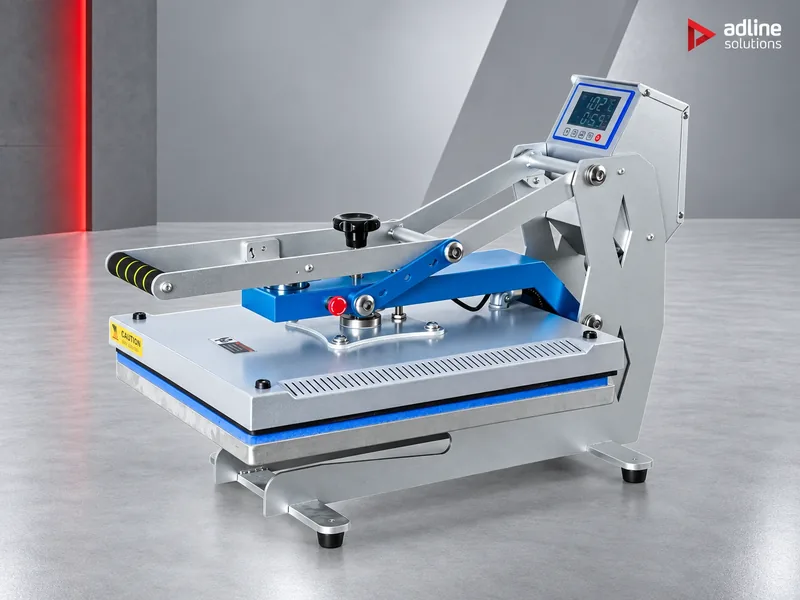
The DTF-Z600 Pro Max runs the first three steps in one roll-to-roll line: two Epson i3200 heads print CMYK and white on 600 mm film at 9 m²/h, and the white ink recirculates to the head so the pigment does not settle. The YXD-HA406 heat press has a 40 × 60 cm platen, 0 to 280 °C with ±0.5 °C accuracy, and opens automatically at the end of the cycle. Use the pressing temperature and time given for the film and powder you buy.
Stickers for hard goods: UV DTF
UV DTF is the hard-goods counterpart of DTF. The printer lays CMYK, white and clear on transfer film and cures it at once; the operator places the sticker on the item, presses it down and peels the carrier. No heat press is used, which makes it the way to decorate tumblers, bottles and uneven items that do not fit under a print head. The UD-06R3CLV (600 mm) and UD-13R3CLV (1300 mm) offer an optional glue channel for gold and silver effects.
Finishing after printing
- Lamination protects wraps, floor graphics and outdoor prints. With eco-solvent, laminate only after the print has dried. The L1-1700 roll laminator from our L-1700 series works up to 1630 mm wide.
- Drying space: eco-solvent prints need room to dry before they are rolled up and laminated; plan it in the workshop layout.
- Heat press capacity: with DTF, the press, not the printer, often sets the pace; plan presses for your daily number of garments.
Examples
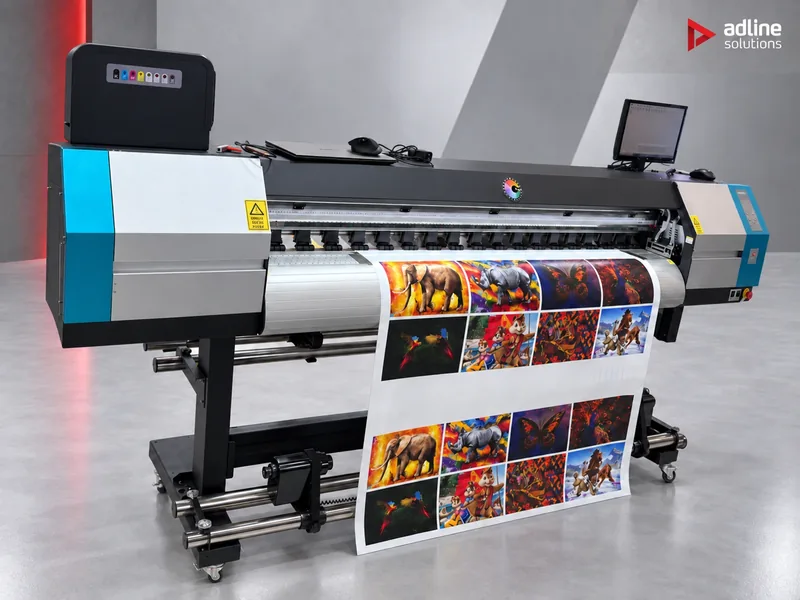
Sign shop starting with vinyl, decals and small wraps.
UD-18R2CL: 1800 mm eco-solvent with one or two Epson i3200-E1 heads, up to 34 m²/h with one head in draft mode.
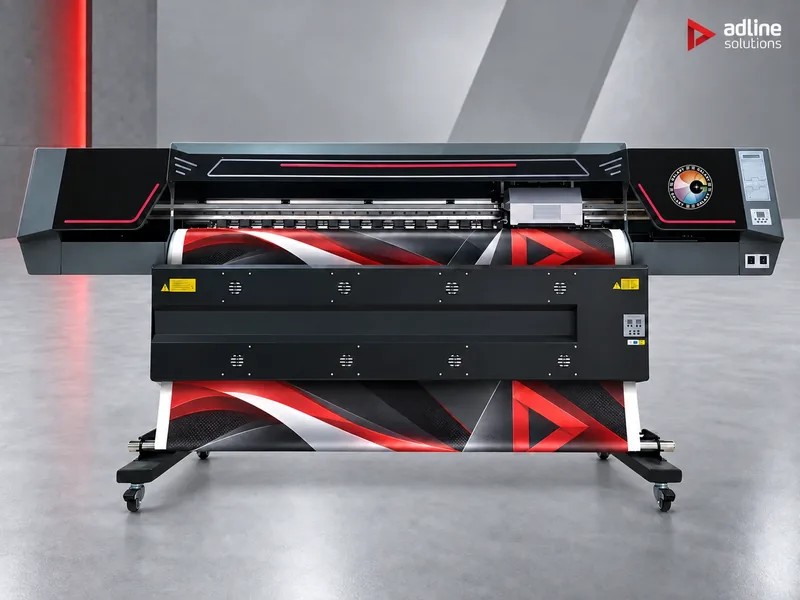
Wrap and banner producer running all day.
UD-1800CN: four heads, over 170 m²/h in 2-pass draft, rated for up to 1,000 m² a day.
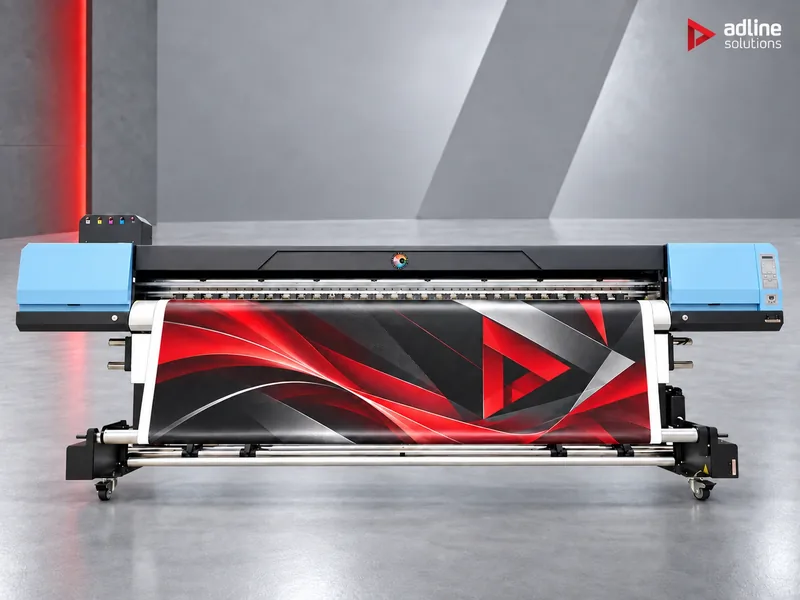
Large banners and billboards.
UD-3200BE: 3200 mm eco-solvent with four heads, over 190 m²/h in 2-pass draft, rated for up to 1,000 m² a day.
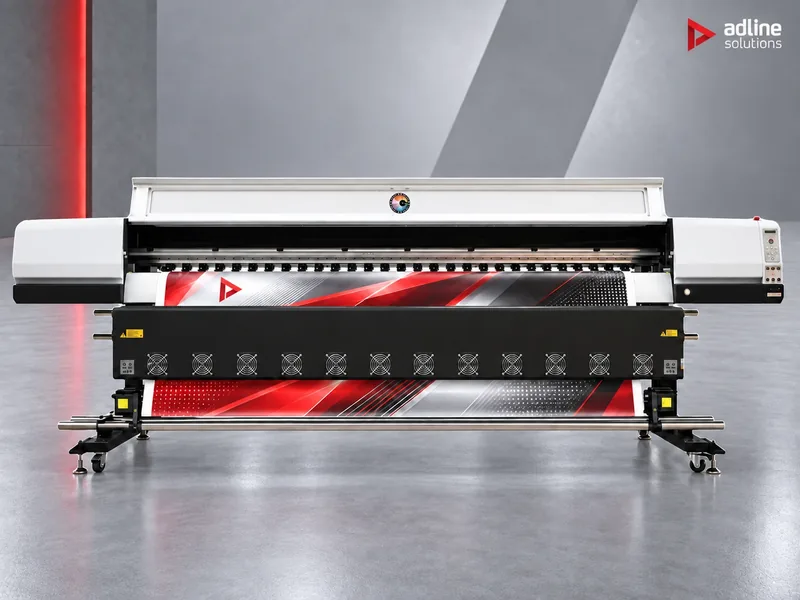
Backlit and same-day banner work at 3.2 m.
UD-3200BEW: UV roll-to-roll with one to four heads, prints come off cured.
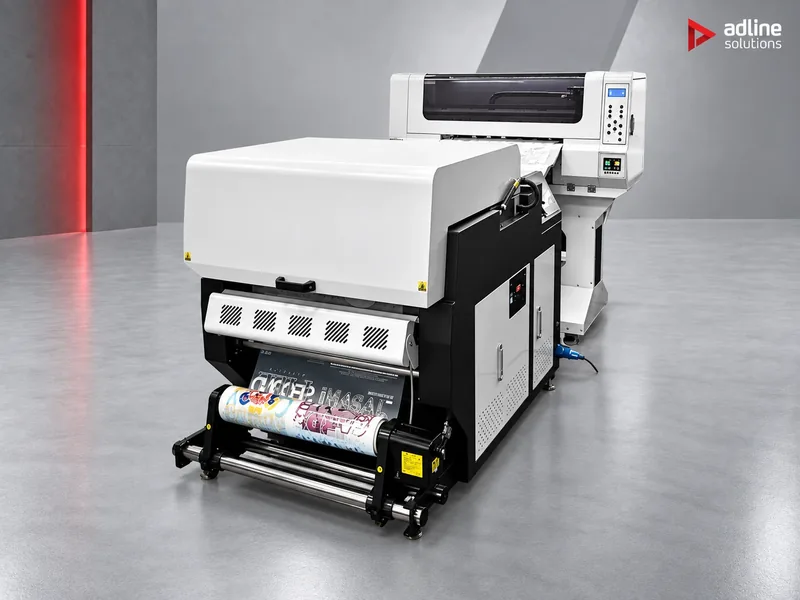
Garment decorator with mixed, short runs.
DTF-Z600 Pro Max for the transfers, with the YXD-HA406 heat press.
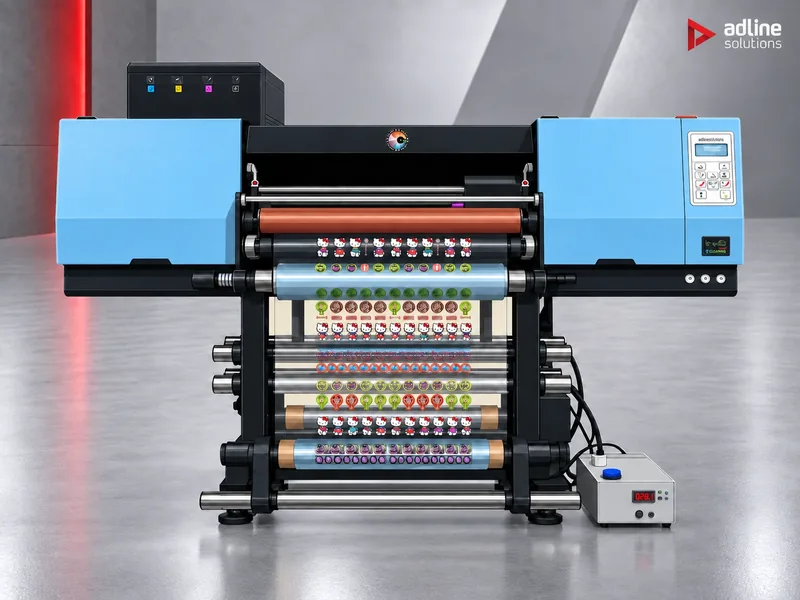
Promotional shop decorating drinkware.
UD-06R3CLV: UV DTF stickers with white, clear and optional gold or silver effects.
Before you order
- Send us what you print, the materials, the roll width and your monthly volume. We recommend the technology, the printer and the number of heads.
- Plan the room: ventilation and drying space for eco-solvent, a heat press station for DTF.
- Installation, operator training and technical service are available and quoted per machine and country.
- You can see printers running in our Bucharest showroom, by appointment.
Frequently asked questions
Is eco-solvent or UV better for vehicle wraps?
Eco-solvent. The ink stays flexible on self-adhesive vinyl, so the print stretches with the film over curves, rivets and recesses. UV suits flat graphics such as window and panel decals, where the print does not have to stretch.
How long do eco-solvent prints need to dry before lamination?
From several hours to a day, depending on ink coverage, media and room conditions. Laminating too early traps solvent under the film.
Can I print T-shirts with a UV printer?
For garments that are worn and washed, choose DTF: the transfer bonds into the fabric with a heat press and works on cotton, polyester and blends, light or dark. UV DTF is for hard goods, not for clothing.
What is the difference between DTF and UV DTF?
DTF prints on PET film, adds adhesive powder and is heat-pressed onto textiles. UV DTF prints a cured sticker that is applied by hand, without heat, onto glass, metal, plastic and wood.
Can one printer do everything?
No single technology covers all of it. A UV hybrid prints rigid boards and rolls; wraps are best in eco-solvent; textiles need DTF and a heat press. Tell us your mix of work and we recommend the combination.