What a digital cutting table does
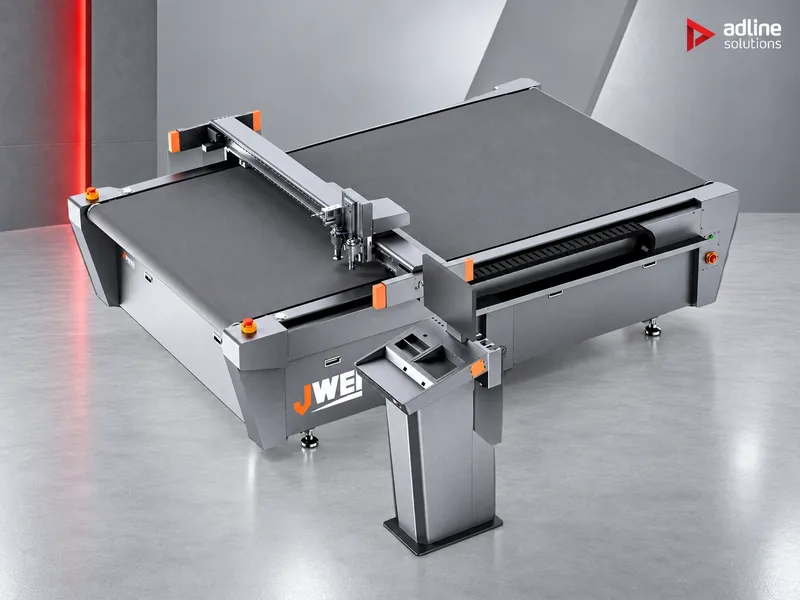
A digital cutting table holds the sheet flat by vacuum and moves knife tools along the outline in the file. There is no die to make, store or wait for: the next job is just another file. A camera reads the registration marks on a printed sheet, so the cut follows the print.
No die
- Samples, prototypes and short runs straight from the file
- Each version or personalised batch is another file
Cut to the print
- A camera registers each printed sheet before cutting
- A QR code on the sheet calls up the right cut file
Several tools, one pass
- Cutting, kiss-cutting and creasing on the same head
- Routing on the Jwei SG and SL tables
Who uses one
- Label and sticker printers
- Packaging designers, box makers, sign and display shops
Start from what you cut
The material and the sheet size decide most of the choice. Find your work in the table, then check the size, the tools and the automation in the steps below.
| What you make | Materials | What decides the choice | Where to start |
|---|---|---|---|
| Labels and stickers | Self-adhesive material, coated and special paper, self-adhesive vinyl | Kiss-cutting through the face but not the liner; registration to the print; sheets or rolls | C6 series: C6-0806 for B2 and SRA3 sheets; roll feeder option for labels on the roll |
| Folding cartons and packaging samples | Card and paper from 80 to 800 g/m² through the feeder, grey board, plastic sheet | Clean creases, slotting, the sheet size | C6 series up to 1000 × 1200 mm; LST03II for board up to 10 mm and its box template library; Jwei SG for larger sheets |
| Corrugated board and displays | Corrugated, greyboard, honeycomb panel, hollow sheet | Board thickness and sheet size | C6 series with corrugated creasing tools, up to 5 mm and 1000 × 1200 mm; LST03II up to 10 mm; Jwei SG or Jwei SC for large sheets and thicker board |
| Signage boards | PVC foam, KT, ABS and aluminium-composite board, acrylic | Thickness, routing, the board size | Jwei SG, with its router module, up to 50 mm; Jwei SL for beds over 3 m; C6 series for foam and KT board up to 5 mm on small sheets |
| Flexible media | Self-adhesive vinyl, magnetic sheet, backlit film, vehicle wrap film, coated cloth | Length of the job and bed size | Jwei SL, on beds of 3250 × 3200 and 5200 × 3200 mm |
| Foam and technical packaging | EPE and EVA foam, PVC and PET | Thickness and the knife | Jwei SG or Jwei SC |
The C6-0806 is our most popular size: its 800 × 600 mm area takes B2 and SRA3 sheets, the formats most print shops already print on.
Step 1: sheets, rolls or a production line
- Sheets from a stack: the C6 series feeds printed sheets automatically from a stack of up to 100 mm, with vacuum and non-contact suction cups, carries them on a conveyor table under the head and discharges the finished work into the receiving tray. Load the stack and press Start.
- Stacks of thicker board: the LST03II feeds from a stack of up to 100 mm (LST03II-0806) or 180 mm (LST03II-0912) and cuts material up to 10 mm thick.
- Labels on the roll: with the optional roll feeder, the C6 series cuts printed labels automatically straight from the roll. For long runs of roll labels, a laser label cutter such as the Jwei LP360 cuts a 350 mm web at up to 80 m/min.
- Boards placed by hand: the Jwei SG, SC and SL hold the board on a vacuum bed with optional zoned suction; the operator places each board.
- Pallet to pallet: the SG1625 Autoline loads sheets up to 1600 × 2500 mm and 4 mm thick from a pallet, cuts and restacks them. The SC1625 is available with a receiving table or with a loading and unloading line for sheets from 600 × 900 to 1600 × 2500 mm, up to 22 mm thick.
Step 2: choose the size
Size the table to the largest sheet you cut regularly, not the occasional one. A larger table also cuts small sheets, but it takes more floor space and more power, and on a sheet-fed table the feeder is sized with the bed.
| Model | Cutting area | Typical sheets |
|---|---|---|
| C6-0604 | 600 × 400 mm | SRA3 and A3+ sheets |
| C6-0806 | 800 × 600 mm | B2 and SRA3 sheets; our most popular size |
| LST03II-0806 | 800 × 600 mm | B2 and SRA3 sheets, board up to 10 mm |
| LST03II-0912 | 900 × 1200 mm | Large carton sheets, board up to 10 mm |
| C6-1012 | 1000 × 1200 mm | Large sheets for cartons and displays |
| Jwei SG: SG1612 | 1600 × 1200 mm | Boards and large sheets |
| Jwei SG: SG1625; SC1625; SG1625 Autoline | 1600 × 2500 mm | Full boards and large corrugated sheets |
| Jwei SC: SC2131 | 2100 × 3100 mm | Oversize boards |
| Jwei SG: SG2132 and SG3232 | 2100 × 3200 and 3200 × 3200 mm | Oversize boards and displays |
| Jwei SL: SL3232 and SL5232 | 3250 × 3200 and 5200 × 3200 mm | Large-format signage and flexible media |
All C6 models take sheets from 210 × 297 mm; the SG1625 Autoline loads sheets from 297 × 420 mm.
Step 3: the tools
The tools decide what the table can do to the material. List the operations your jobs need, then check that the table carries the tools for them.
| Tool | What it does | Machines |
|---|---|---|
| Electric oscillating knife | A vibrating blade that cuts card, board and foam without tearing | C6 series (standard), LST03II (mini oscillating knife), Jwei SG, SC and SL (supplied) |
| Universal or drag knife | A fixed blade for paper, film and vinyl | C6 series (universal cut tool, standard), LST03II (passive knife), Jwei SG, SC and SL (drag knife) |
| Kiss-cut tool | Cuts through the face of self-adhesive material and leaves the liner whole | C6 series (standard), LST03II |
| Creasing tool | Presses fold lines into card and board | C6 series (standard; corrugated creasing tools optional), LST03II (creasing wheel, also for corrugated), Jwei SG (cutting and creasing in one pass) |
| V-cut tool | An angled cut for folding thick board | C6 series (optional), LST03II, Jwei SC and SL (optional, for grey board) |
| Perforating tool | Tear-off and fold perforations | C6 series (optional) |
| Slotting | Narrow slots in card and board | C6 series (double-knife slotting tool for white card and grey board, optional), LST03II (slotting function on the EOT head) |
| Router | Mills aluminium-composite, acrylic and thick boards | Jwei SG, SL and SG1625 Autoline (router module supplied), Jwei SC (milling cutter, optional) |
| Rotary knife | A rolling blade for flexible media | Jwei SG and SL (supplied), Jwei SC (optional) |
| Electric foam knife | Cuts thick foam board | Jwei SC and SL (optional) |
Step 4: speed, camera and automation
- Speed: up to 1200 mm/s on the C6 series, 1500 mm/s on the LST03II, 1800 mm/s on the Jwei SC, 2000 mm/s on the Jwei SG and the SG1625 Autoline, and 3000 mm/s on the linear-motor Jwei SL.
- Real output: top speed is reached on long, straight cuts. The C6 series cuts an SRA3 or A3+ sheet in 15 – 45 s, depending on the shapes; the LST03II takes 15 – 45 s per SRA3 sheet and about 70 s per B2 sheet.
- Precision: ±0.1 mm repeatability on the C6 series and the LST03II; under 0.05 mm on the Jwei SG, SL and SG1625 Autoline, ±0.05 mm on the Jwei SC.
- Camera registration: the C6 series has an industrial CCD camera, and all the Jwei tables position by camera, so the cut follows the printed sheet.
- QR codes: a QR code printed on the sheet loads the matching cut file, on the C6 series and the Jwei tables, so mixed jobs and personalised batches run without setup between sheets.
- Control: the Jwei SG and SC run from their own touch-screen control platform, without a computer; the C6 series uses its own control software with an English interface.
Our cutting tables compared
| Machine | Cutting area | Max speed | Max thickness | Feeding | Best for |
|---|---|---|---|---|---|
| C6 series | 600 × 400, 800 × 600 or 1000 × 1200 mm | 1200 mm/s | 5 mm, depending on material | Automatic sheet feeder, stack up to 100 mm; roll feeder optional | Labels, stickers, folding cartons, samples and short runs from printed sheets |
| LST03II | 800 × 600 or 900 × 1200 mm | 1500 mm/s | 10 mm | Automatic feed, stack up to 100 or 180 mm | Packaging and labels in thicker board, with a box template library |
| Jwei SG | 1600 × 1200 to 3200 × 3200 mm | 2000 mm/s | 50 mm, depending on material and tool | Placed on the vacuum bed | Packaging, displays and signage; cutting, creasing and routing with two or three heads |
| SG1625 Autoline | 1600 × 2500 mm | 2000 mm/s | 50 mm cutting; sheets up to 4 mm through the loader | Auto Loader and Auto Stacker, up to 650 mm including the pallet | Unattended production of large sheets |
| Jwei SC | 1600 × 2500 or 2100 × 3100 mm | 1800 mm/s | 50 mm on the SC1625, depending on material and tool | Receiving table or loading and unloading line (SC1625) | Industrial packaging and sign work; boards up to 22 mm on the line |
| Jwei SL | 3250 × 3200 or 5200 × 3200 mm | 3000 mm/s | 50 mm, depending on material and tool | Placed on the vacuum bed | Large-format signage, rigid boards and flexible media |
Examples
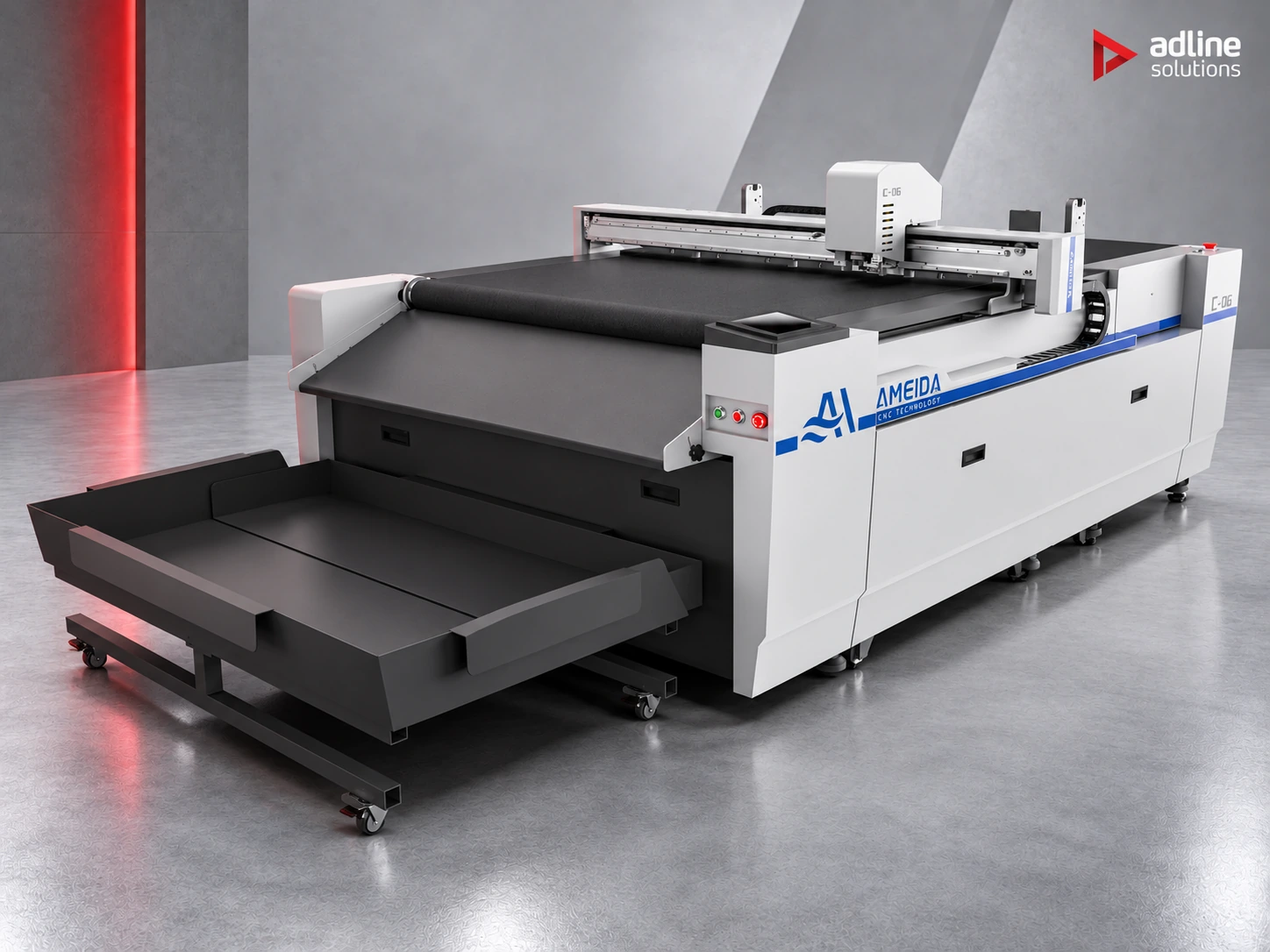
Box maker cutting thicker board samples.
LST03II: board up to 10 mm, a creasing wheel for corrugated board and a library of over 1000 box templates.
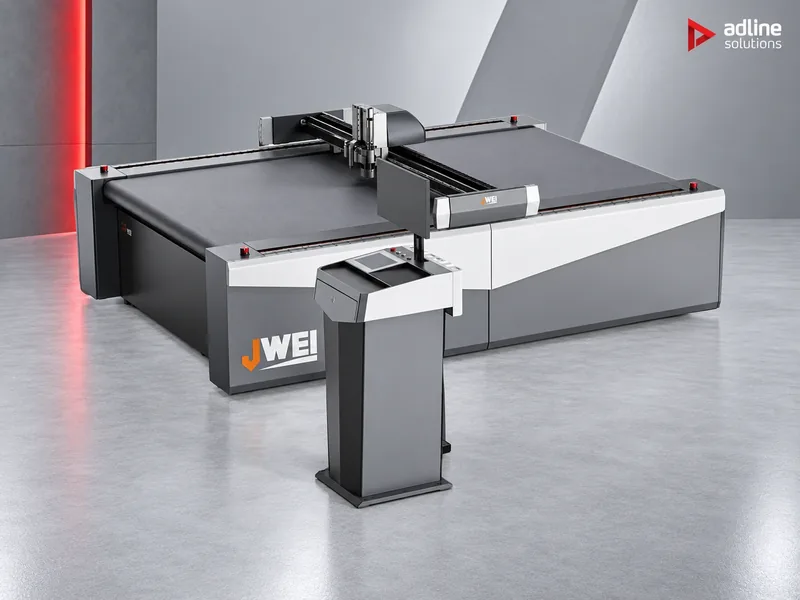
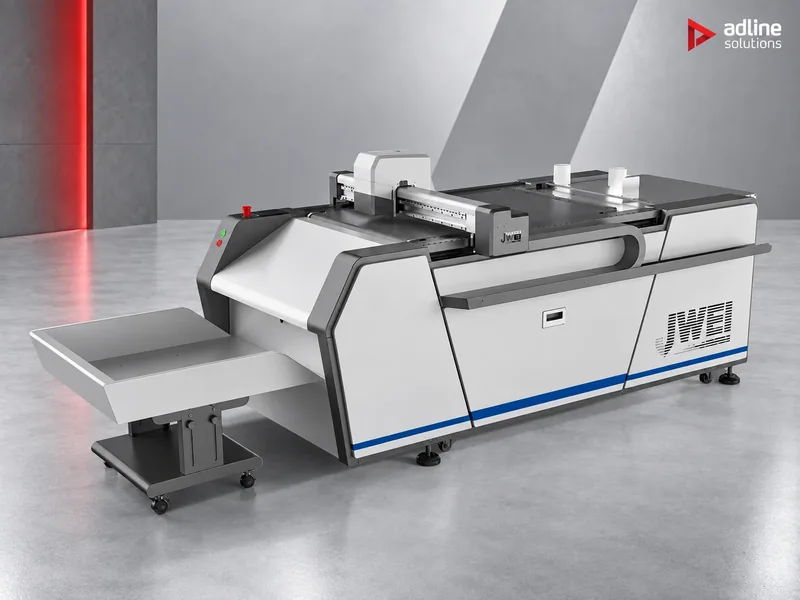
Sign and display shop cutting and routing boards.
Jwei SG: two or three heads cut, crease and route foam, aluminium-composite and acrylic boards up to 50 mm, on beds from 1600 × 1200 mm.
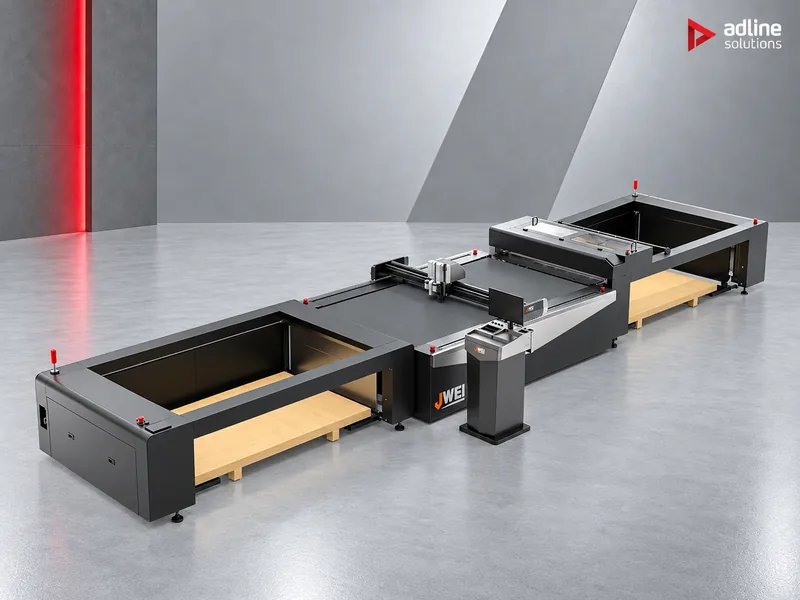
High-volume corrugated converter.
SG1625 Autoline for sheets up to 4 mm from a pallet, or the SC1625 with its loading and unloading line for board up to 22 mm.
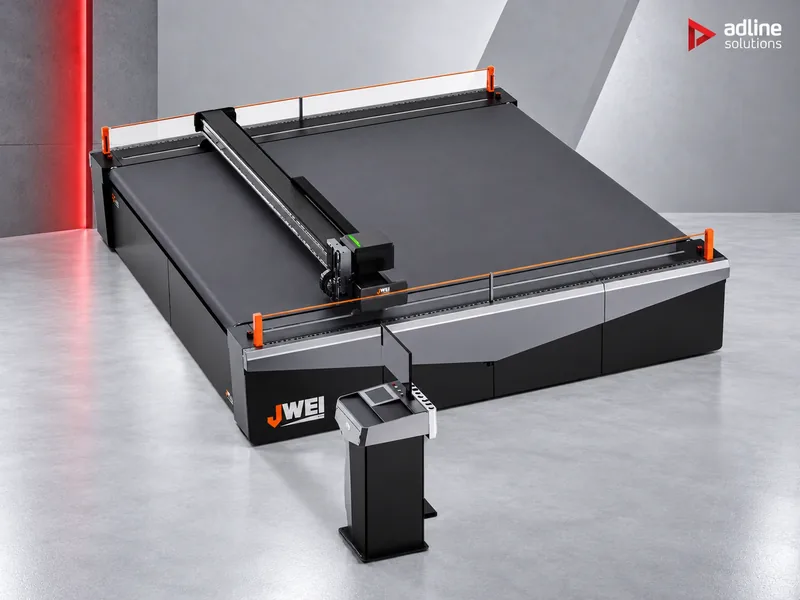
Large-format print shop with vinyl, wrap film and boards.
Jwei SL: 3000 mm/s on beds up to 5200 × 3200 mm. See our eco-solvent printer guide for the printers.
Common mistakes
- Buying for the largest sheet you might get once. Size the table for the sheets you cut every week: a larger table takes more floor space and power, and a sheet-fed table sizes its feeder with the bed.
- Choosing on top speed alone. Output depends on the shapes and the tool changes; compare the time per sheet on your own artwork.
- Forgetting the creasing. Folding cartons and corrugated boxes need clean creases as much as clean cuts; check the creasing tools for your board.
- Thick boards on a light table. The C6 series cuts up to 5 mm; for thicker board and routing, choose a Jwei table.
- Printing without registration marks. Camera registration needs marks on the sheet; add them, and a QR code, in the print layout.
Glossary
- Kiss-cut: a cut through the face of a self-adhesive material that leaves the liner whole.
- Creasing: pressing a fold line into card or board, so it folds cleanly.
- Oscillating knife: a blade that vibrates up and down at high speed, for card, board and foam.
- Registration marks: printed marks the camera reads to align the cut with the print.
- ATC: automatic tool change, on the Jwei SG and SL.
- Die: a steel-rule cutting form made for one shape; a digital table needs none.
Before you order
- Send us what you cut, the materials and thicknesses, the largest sheet and your monthly volume. We recommend the table, the size and the tools.
- Send a few of your own files and printed sheets: we can show how they cut.
- Check the site: floor space for the table and the feeder or line, single-phase 220 V for the C6 series or 380 V for the Jwei tables.
- Installation, operator training and technical service are available and quoted per machine and country.
- You can see the machines running in our Bucharest showroom, by appointment.
Frequently asked questions
What is die-free cutting?
A digital cutting table cuts and creases from the file with knife tools, so no cutting die is made. Samples, short runs and personalised batches start as soon as the file is ready.
Which cutting table is best for labels and stickers?
The C6 series. It kiss-cuts self-adhesive material from a stack of printed sheets, registers each sheet with a CCD camera and, with the optional roll feeder, also cuts labels from the roll. The C6-0806 (800 × 600 mm) takes B2 and SRA3 sheets.
Can a digital cutting table cut corrugated board?
Yes. The C6 series cuts and creases board up to 5 mm with its corrugated creasing tools, the LST03II up to 10 mm, and the Jwei SG and SC up to 50 mm, depending on material and tool.
Which file formats do the tables accept?
The C6 series reads DXF, HPGL, PDF and PLT. The LST03II reads PLT and DXF, and the LST03II-0912 also XML and CF2. The Jwei SG, SC and SL tables are HP-GL compatible. All connect over Ethernet.
How does camera registration work?
A camera reads the registration marks printed on the sheet and aligns the cut path to the print, so the cut follows the artwork even if the sheet sits slightly off. A QR code on the sheet can also load the right cut file.
Should I cut from sheets or from the roll?
Most labels and cartons are printed and cut as sheets: the C6 series feeds them from a stack. For labels printed on the roll, the C6 roll feeder cuts them straight from the roll.
How big a cutting table do I need?
Size it to the largest sheet you cut regularly. The C6 series covers sheets up to 600 × 400, 800 × 600 or 1000 × 1200 mm; the Jwei tables go from 1600 × 1200 up to 5200 × 3200 mm.