What a handheld laser welder does
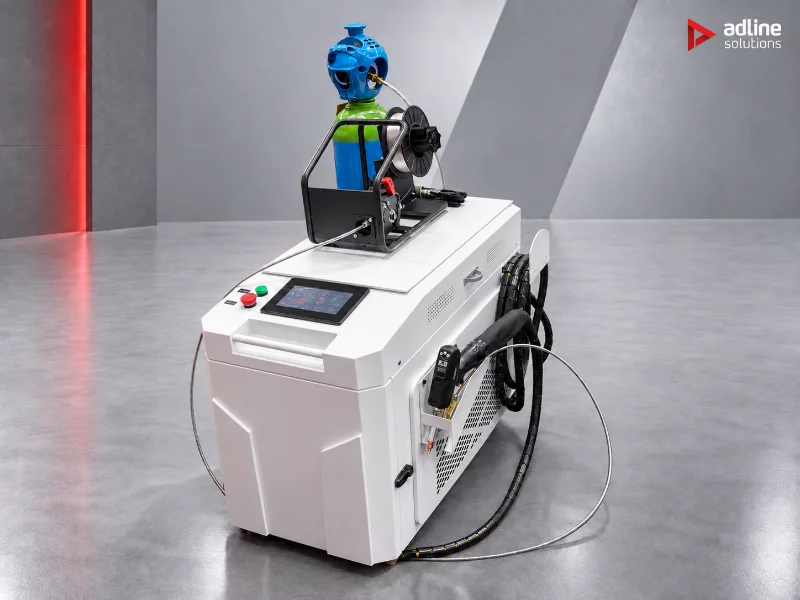
A fibre laser source in a mobile cabinet sends the beam through an optical fibre to a light welding head. The operator guides the head along the joint like a torch, but the energy arrives as a focused beam a few millimetres wide instead of an arc. The weld pool is small, the metal around it stays cool, and the bead comes out fine and even. On the Hanma HT the head weighs no more than 600 g, so it can be held through a full shift.
Welding
- Continuous, spot or oscillating
- With or without filler wire
Cleaning
- Cleaning mode on the same head
- Rust, paint, oxides and oil removed before welding
Little distortion
- A narrow heat-affected zone
- Thin sheet stays flat, visible faces stay clean
Quick to learn
- Presets by metal and thickness
- Settings changed at the workpiece from the Wi-remote
Start from what you weld
| Your work | Typical metal and thickness | Where to start |
|---|---|---|
| Channel letters, light boxes, signage | Stainless steel and aluminium, 0.5 – 3 mm | HT1500; HT2000 if aluminium is daily work |
| Enclosures, cabinets, sheet metal parts | Stainless and carbon steel, 1 – 3 mm | HT1500 |
| Railings, gates, fences | Stainless and carbon steel tube and sheet, 2 – 4 mm | HT2000 |
| Frames, brackets, light structures | Carbon steel, 4 – 6 mm | HT3000 |
| Mixed workshop, including aluminium and copper | Several metals, up to 3 – 4 mm | HT2000 |
| Repair and maintenance on site | Mixed, often thin | HT1500 or HT2000, on single-phase 220 V |
The selector at the top of this page does the same in three questions. The steps below explain each choice.
Laser, TIG or MIG: what the research shows
Laser welding has been compared with arc welding in laboratories for years. The studies below measured speed, heat, distortion, strength and fume on the same material, welded both ways. They were made with laboratory and industrial equipment, not with a particular handheld machine, so they show the difference between the processes rather than a guaranteed result.
| What was measured | Pulsed laser | Pulsed TIG |
|---|---|---|
| Welding speed | 160 mm/min | 32.5 mm/min |
| Width of the heat-affected zone | 0.75 mm | 7.65 mm |
| Maximum angular distortion | 0.91° | about 6.3° |
| Residual stress near the weld | about 100 MPa, compressive | about 430 MPa, tensile |
| Tensile strength of the joint | 806 MPa | 804 MPa |
| Joint efficiency | 95.4% | 95.2% |
Source: Junaid et al., Journal of Materials Processing Technology, 2017, on thin titanium alloy sheet. The laser joint was about five times faster to weld, its heat-affected zone was ten times narrower and the sheet distorted about seven times less, while the joint was as strong as the TIG joint: both broke in the parent metal, not in the weld.
Laser weld
A beam about 1 – 4 mm wide: a narrow bead, a heat-affected zone under a millimetre wide and a sheet that stays flat.
TIG weld
A wide arc: a broad bead, a heat-affected zone around ten times wider, and a sheet that pulls out of line as it cools.
Other findings that matter in a workshop:
- Less fume: in a doctoral study at the Silesian University of Technology, arc welding produced about 3.5 times as much fume per second as laser welding at the same energy per millimetre, and MIG produced the most. More than 20% of the laser fume particles were still small enough to be breathed in, so extraction is still needed.
- Cleaner joints, fewer pores: laser cleaning before welding cut porosity in welded aluminium from 10 – 80% to under 0.5% in fillet edge welds (Al Shaer, Li and Mistry, Optics and Laser Technology, 2014).
- Skill still counts: a 2025 study at Óbuda University found weld deviations on handheld laser welds even at the maker's recommended settings, and concluded that quality also depends on the welder. Presets shorten the learning curve; test pieces and training make the results consistent.
| Handheld laser | MIG | TIG | Stick | |
|---|---|---|---|---|
| Sheet thickness | 0.5 – 6 mm, by power | From 0.6 mm | From 0.3 mm | Above 2 mm, unsuited to thin sheet |
| Thermal distortion | Minimal | Moderate | Moderate | High |
| Cleaning after welding | Usually none | Spatter to remove | Little | Slag to remove |
The trade-off is the initial investment, which is higher than for an arc welder. Running costs stay low: shielding gas consumption is modest and filler wire is often not needed. For heavy structural work above 6 – 8 mm, MIG or a dedicated process remains the right choice.
Step 1: choose the power by thickness and joint
The thickest sheet you weld regularly decides the power, and the joint decides how much power that thickness needs. A butt joint has to be penetrated through the full thickness; a corner or lap joint lets the same power carry more material.
Single-pass thickness by model
Carbon steel, handheld, at a reasonable travel speed. Corner and lap joints carry more thickness than butt joints at the same power.
These are ranges for sound single-pass handheld welding on carbon steel at a reasonable travel speed. Above them the machine still welds, but more slowly, sometimes in several passes and with less consistent quality. A machine sized to your thickest regular job, not your rare exception, gives the best result per hour.
Step 2: know your metals
Metals do not take the beam equally. Stainless steel absorbs the 1064 nm fibre laser wavelength well; aluminium and copper reflect much of it and carry the heat away fast. The presets on the Hanma HT show this clearly: on the HT2000, at the same 2 mm thickness, the preset peak power rises with each metal.
| Metal, 2 mm (HT2000 preset) | Peak power | Why |
|---|---|---|
| Stainless steel | 39% | Absorbs the laser well, needs the least power |
| Carbon steel | 45% | Slightly more power for the same penetration |
| Aluminium | 50% | Reflective; needs more power and clean, oxide-free edges |
| Copper | 55%, with slower wire feed (8 mm/s) | The most reflective and the best heat conductor; the hardest to weld |
- Stainless steel: the natural metal for laser welding. Thin visible parts stay flat and the bead often needs no finishing.
- Carbon steel: welds well; clean off rust, mill scale and oil first, which the cleaning mode does on the same head.
- Aluminium: needs more power and clean edges. On the HT1500 aluminium is welded from a custom profile, up to about 2 mm; the HT2000 has it in the presets.
- Copper: reserved for the higher powers. On the HT2000 it is in the presets, up to about 2 mm.
Step 3: prepare the joint
A laser weld pool is small, so fit-up matters more than with MIG. Three tools on the head help with real parts that are never perfect:
Adjustable spot
- 1 – 4 mm, set by the oscillation module
- Wide for imperfect fit-up, narrow for thin or small welds
Oscillation
- The beam sweeps across the joint
- Bridges wider joints and fillets evenly
Filler wire
- Fills gaps and builds up fillets
- V rollers for steel wire, U rollers for aluminium
Clean first
- Cleaning mode removes oxides and oil
- Fewer pores, especially on aluminium
- Tack, then weld: spot mode holds parts in place before the continuous pass.
- Keep gaps tight on butt joints: without filler wire, a butt joint should close with almost no gap.
- Test on offcuts: weld a test piece of each new metal and thickness before the real part, and keep the settings that work.
Reading the controller
The Hanma HT controller works in two modes. In preset mode you choose the metal and the thickness, and the welding parameters fill in by themselves. In custom mode you set them by hand, for metals and thicknesses outside the presets or to correct penetration, distortion or spatter. Knowing what each value does makes both modes easier.
| Parameter | What it controls |
|---|---|
| Laser power | The rated power of the source: 1500, 2000 or 3000 W. Fixed by the machine. |
| Peak power (%) | The share of the rated power used. More gives deeper penetration, but risks burning through thin sheet. |
| PWM ratio (%) | How long the beam is on in each pulse. At 100% the laser is practically continuous; below 100% it pulses and puts less heat into the part, which helps on heat-sensitive work. |
| PWM frequency (Hz) | How many pulses the laser fires per second. |
| Scan frequency (Hz) | How fast the beam oscillates from side to side across the joint. |
| Weld width (mm) | How wide the beam sweeps. A wider sweep covers wider joints. |
| Wire speed (mm/s) | How fast the filler wire feeds, when wire is used. |
The controller also offers fine PWM adjustment, ramp-up and ramp-down at the start and end of the weld, and delay jet.
Step 4: plan the workstation
| Need | What the Hanma HT requires |
|---|---|
| Cooling | Integrated water cooling with constant temperature; at least 1.8 L/min of flow, 170 – 520 kPa inlet pressure |
| Cooling water | Distilled water, hardness below 250 mg/L CaCO₃, pH 6 – 8, particles below 200 µm |
| Shielding gas | Argon 99.998%, nitrogen 99.99% or helium 99.998%, through a 6 mm hose |
| Electrical supply | HT1500 and HT2000: single-phase 220 V, 50/60 Hz |
| Cabinet (HT1500 and HT2000) | 910 × 540 × 650 mm |
| Working conditions | 5 – 45 °C, 5 – 85% humidity |
The standard configuration includes:
- The laser source with integrated cooling
- The HW980 welding head with Wi-remote
- A wire feeder with V and U rollers
- Laser safety glasses for 1064 nm
- Earth clamp, gas hose and cables
- Manual and preset parameters
Distilled water, the shielding gas and the pressure regulator are bought locally. Hard or dirty water scales the cooling passages and shortens the life of the optics, which is why the water limits are worth keeping.
Step 5: work safely with a Class 4 laser
A handheld laser welder is a Class 4 laser product, the highest laser hazard class. Direct and reflected beams can cause permanent eye injury, and the risk is greatest on reflective metals such as aluminium and copper. The machine is built to EN ISO 11553-2, the safety standard for handheld laser processing machines, but the workplace has to be set up for it too.
Laser glasses, always
- Rated for the 1064 nm wavelength
- Ordinary welding helmets and glasses do not protect against the laser
A controlled area
- Screened with laser-blocking curtains or panels
- Access only for trained people, with a warning sign
Built-in interlocks
- The beam fires only with the trigger pressed
- A contact sensor on the workpiece
Fume extraction
- Less fume than arc welding, but fine particles
- Extract at the source
- Appoint a person responsible for laser safety and write a short working procedure: who may weld, where, with what protection.
- Protect the skin as well as the eyes: the beam, reflections, heat and sparks call for gloves and flame-resistant clothing.
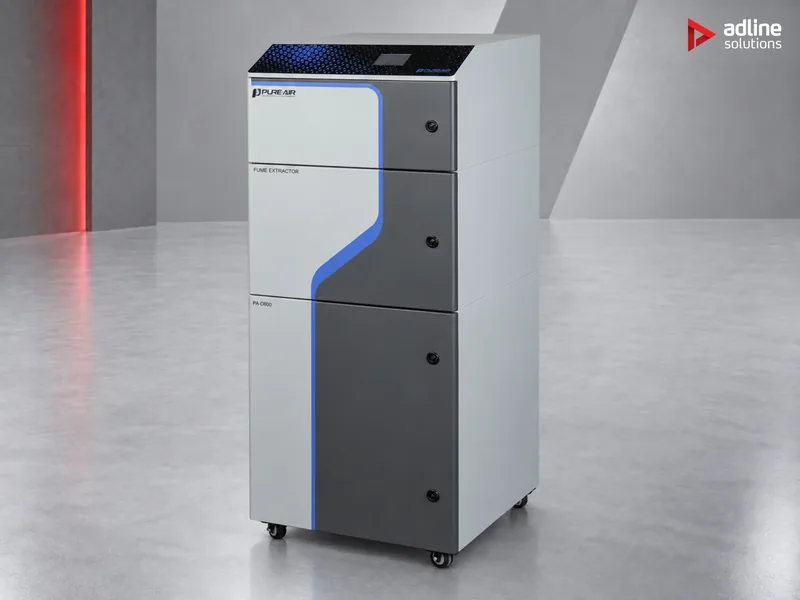
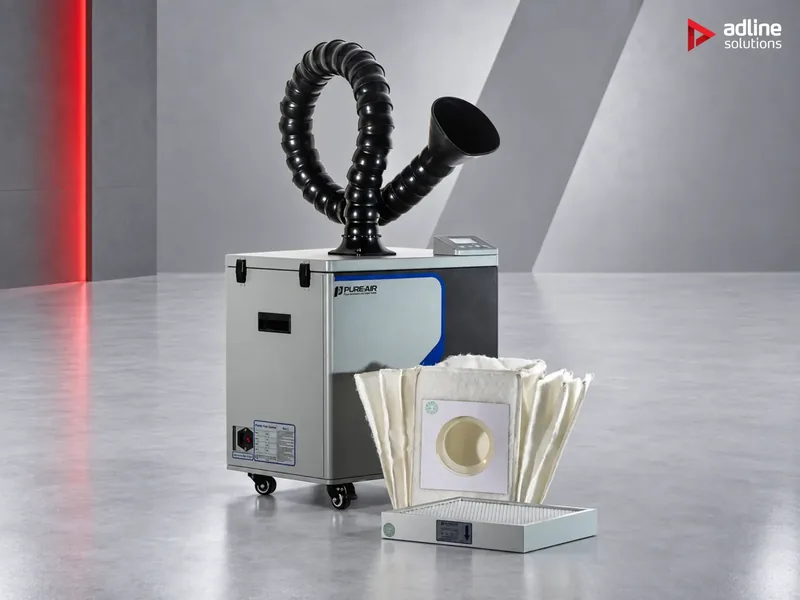
- Extract the fume at the source: a high-vacuum extractor such as the PURE-AIR PA-D350 or PA-D800, made for laser and TIG welding at a single station, captures fine metal particles before they spread. See our fume extractor guide.
Our handheld laser welders compared
| Hanma HT1500 | Hanma HT2000 | Hanma HT3000 | |
|---|---|---|---|
| Laser power | 1500 W | 2000 W | 3000 W |
| Butt joint, full penetration | 2 – 3 mm | 3 – 4 mm | 5 – 6 mm |
| Corner or lap joint | 3 – 4 mm | 4 – 5 mm | 6 – 8 mm |
| Metals in the presets | Stainless and carbon steel; aluminium from a custom profile | Stainless steel, carbon steel, aluminium, copper | Ask us |
| Electrical supply | Single-phase 220 V | Single-phase 220 V | Ask us |
| Welding head | HW980, ≤ 600 g, Wi-remote | HW980, ≤ 600 g, Wi-remote | HW980, ≤ 600 g, Wi-remote |
| Modes | Welding, cleaning, wire feed | Welding, cleaning, wire feed | Welding, cleaning, wire feed |
| Best for | Signage, enclosures, thin stainless | Mixed workshops, aluminium and copper | Thicker frames and structures |
All three share the same head, controller, cooling and wavelength (1064 nm); only the laser power, and with it the thickness and the metals in the presets, changes. Choose by the thickness you weld most often.
Examples
Sign maker welding stainless channel letters and light boxes.
HT1500: fine joints between face and returns on thin stainless sheet, with no distortion on the visible face. See our channel letter guide.
Sheet metal shop making stainless enclosures.
HT1500: corner joints up to 3 – 4 mm, little or no grinding before painting or polishing.
Railing and gate maker in stainless and steel.
HT2000: tube and sheet up to 4 mm, with the cleaning mode for rust and mill scale on site.
Workshop welding aluminium profiles and panels.
HT2000: aluminium in the presets up to about 3 mm; clean the edges first.
Fabricator of frames and brackets.
HT3000: 5 – 6 mm butt and up to 8 mm corner joints in one pass, MIG kept for the heaviest work.
Where handheld laser welding pays
- Channel letters: fine joints between the face and the returns, with no distortion on the surface the customer sees. See our channel letter guide.
- Light boxes and frames: fast assembly of thin profiles and sheets, with a clean bead that does not spoil the seal.
- Totems and poles: light structural joints without distorting the visible panels.
- Perforated and decorative panels: thin elements fixed without burning or warping them.
- Brackets and support structures: ready for powder coating or painting without grinding.
- Metal fabrication: stainless and steel enclosures, railings, gates and fences.
- Repair and maintenance: welding parts that cannot be taken to a welding bench.
Common mistakes
- Buying the power for the rare job: size the machine to your regular thickness; for occasional heavy welds, keep the MIG.
- Welding dirty metal: oil, paint and oxide cause pores; clean the joint first, with the cleaning mode or by hand.
- Wearing a welding helmet instead of laser glasses: an arc welding filter does not stop the 1064 nm beam.
- Using tap water in the cooling circuit: scale shortens the life of the optics; use distilled water.
- Skipping test pieces: a few offcuts of each metal and thickness save rejected parts.
- No extraction: less fume than arc welding is still fume.
Glossary
- Butt joint: two edges side by side, welded through the full thickness.
- Corner, lap and fillet joints: sheets meeting at an angle, overlapping or forming a T; the weld does not have to go through the full thickness.
- Heat-affected zone (HAZ): the metal beside the weld that heats up enough to change, without melting.
- Oscillation (wobble): the beam sweeping from side to side across the joint, to widen the weld and bridge gaps.
- Filler wire: wire fed into the weld pool to fill gaps and build up fillets.
- Shielding gas: argon, nitrogen or helium blown over the weld to keep air away from the molten metal.
- QBH: the connector that joins the optical fibre to the welding head.
- Class 4 laser: the highest laser hazard class; direct and reflected beams can injure eyes and skin.
Before you order
- The metals you weld and the thickest sheet you weld every week
- The joints you use most: butt, corner, lap or fillet
- Whether you need filler wire for gaps or fillets
- Your electrical supply, shielding gas and cooling water
- A space you can screen off as the laser working area
- How many people will weld, and their experience
- Photos of typical parts, and parts we can weld as test pieces
Frequently asked questions
Where can I buy a handheld laser welder in Europe?
Adline Solutions, based in Bucharest, Romania, supplies the Hanma HT handheld fibre laser welders, in 1500, 2000 and 3000 W versions, with delivery across the European Union. Send us your metals and thicknesses and we weld test pieces before you decide. Installation, operator training and service are available and quoted per machine and country.
How thick can a handheld laser welder weld?
It depends on the power and the joint. On carbon steel, in one pass, the Hanma HT1500 welds 2 – 3 mm butt joints and 3 – 4 mm corner and lap joints, the HT2000 3 – 4 mm and 4 – 5 mm, and the HT3000 5 – 6 mm and 6 – 8 mm.
Is laser welding faster than TIG?
On thin sheet, yes. In a laboratory comparison on thin titanium alloy sheet, pulsed laser welding ran at 160 mm/min against 32.5 mm/min for pulsed TIG, about five times faster, with a ten times narrower heat-affected zone and about seven times less distortion, and the joints were equally strong.
Can a handheld laser welder weld aluminium and copper?
Yes, with enough power and clean edges, because both metals reflect much of the laser. The Hanma HT2000 has aluminium and copper in its presets, up to about 3 mm and 2 mm; on the HT1500 aluminium is welded from a custom profile, up to about 2 mm.
Do I need special glasses for laser welding?
Yes. A handheld laser welder is a Class 4 laser, and the glasses must be rated for its wavelength, 1064 nm for a fibre laser. Ordinary welding helmets and safety glasses do not protect against the laser beam or its reflections.
Does laser welding produce fumes?
Less than arc welding, but it does. In one study arc welding produced about 3.5 times as much fume as laser welding at the same energy per millimetre, yet more than 20% of the laser fume particles were small enough to be breathed in. Extract the fume at the source.
What does a handheld laser welder need on site?
Distilled water for the integrated cooling, shielding gas (argon, nitrogen or helium) with a pressure regulator, a suitable electrical supply (single-phase 220 V for the HT1500 and HT2000) and a working area screened off for the laser.
Is a handheld laser welder hard to learn?
It is quicker to learn than TIG, because the presets set the parameters by metal and thickness. Quality still depends on the operator, so welding test pieces and a short training at delivery make the results consistent.