
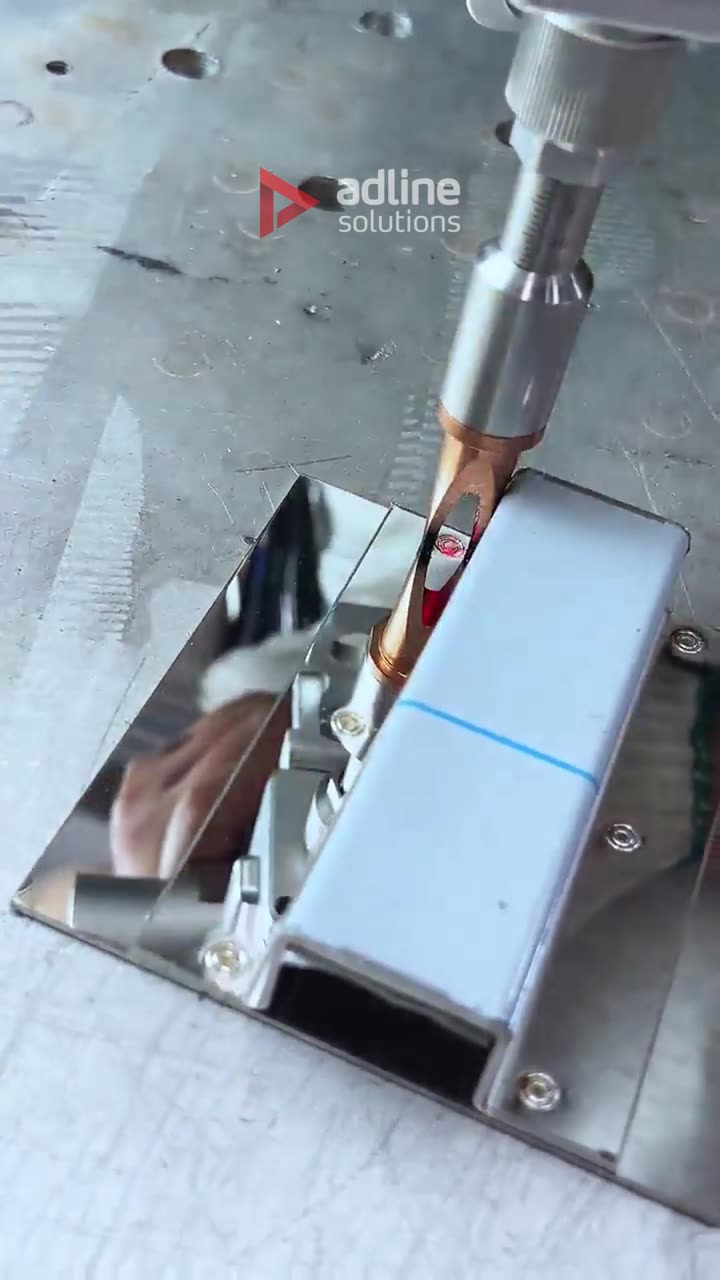
Hanma HT Handheld Fibre Laser Welding and Cleaning Machine
In stock: Hanma HT1500, Hanma HT3000
- Supplied at 1500 W, 2000 W or 3000 W with a QBH fibre interface
- HW980 head, ≤600 g and 42 mm wide, for long working sessions
- Spot adjustable 1 – 4 mm via the oscillation module and focusing lens
- Continuous, spot and oscillating welding modes, plus wire feed
- Cleaning mode built into the same head as the welding modes
- Touchscreen control with Wi-remote parameter changes at the workpiece
Handheld fibre laser welder and cleaner at 1500, 2000 or 3000 W, with a ≤600 g HW980 head and a spot adjustable from 1 to 4 mm.
Which power, gas and safety set-up? Read the guide- Laser welding
- Laser cleaning
- Metal
- Stainless steel
- Aluminium
- Metal fabrication
- Channel letters
- Signage & advertising
Configurations
| Configuration | Differences | Availability |
|---|---|---|
| Hanma HT1500In stock | Maximum applicable laser power: 1500 W · Butt joint, full penetration: 2 – 3 mm · Corner or lap joint: 3 – 4 mm | In stock |
| Hanma HT2000On request | Maximum applicable laser power: 2000 W · Butt joint, full penetration: 3 – 4 mm · Corner or lap joint: 4 – 5 mm | On request |
| Hanma HT3000In stock | Maximum applicable laser power: 3000 W · Butt joint, full penetration: 5 – 6 mm · Corner or lap joint: 6 – 8 mm | In stock |
About this machine
Hanma HT Handheld Fibre Laser Welding and Cleaning Machine
The Hanma HT is a seventh-generation handheld fibre laser welding machine for manual work that has to be accurate. It is supplied as HT1500, HT2000 or HT3000, rated for a maximum applicable laser power of 1500 W, 2000 W or 3000 W, with the source coupled to the head through a QBH fibre interface at a wavelength of 1064 nm. The HW980 head weighs no more than 600 g and is 42 mm wide, which is what makes it practical to hold through a full shift rather than for a few short seams.
The beam is shaped by a Ø20 mm collimating lens with a 50 mm focal length and a Ø20 mm focusing lens with a 150 mm focal length, through a maximum clear aperture of 16 mm. The oscillation module together with the focusing lens gives a spot adjustable from 1 to 4 mm: a wide spot spreads the energy across a joint and copes with imperfect fit-up, a narrow one concentrates it where the material is thin or the weld must stay small. Welding runs in continuous, spot or oscillating mode, and wire feed with 1.0, 1.2 or 1.6 mm filler wire is available where a gap has to be bridged.
The same head also carries a cleaning mode, so one machine covers both welding and surface cleaning without changing equipment. Parameters are set from a touchscreen and can be changed at the workpiece through the integrated Wi-remote, which saves walking back to the cabinet between passes. Further control functions include fine PWM adjustment, ramp-up and ramp-down, and delay jet; the controller interface works with 24 V DC, RS485, a PWM signal and solenoid valve control.
Above 500 W the head must be water cooled. The cabinet has its own chiller, filled with 15 – 20 L of distilled or deionised water, so the workshop does not need a separate water supply; the limits for that internal circuit are at least 1.8 L/min (0.48 gpm) of flow, an inlet pressure of 170 – 520 kPa (30 – 60 psi), water hardness below 250 mg/L as CaCO₃, a pH of 6 – 8 and particles no larger than 200 µm. Those figures are not decoration — dirty or hard water scales the cooling passages and shortens the life of the optics. Shielding gas is argon at 99.998%, nitrogen at 99.99% or helium at 99.998%, fed through a 6 mm hose to a Ø12 mm nozzle 80 mm long, made to a tolerance of −0.02 mm to −0.04 mm. The lenses are protected against spatter burns and particles.
On site the machine needs a single-phase 220 V supply for the 1500 W and 2000 W models or a three-phase 380 V supply for the 3000 W model, a dedicated earth of no more than 4 Ω, and argon or nitrogen at 0.15 – 0.3 MPa through a pressure regulator. The full list is under Site requirements in the specifications. With the dedicated cutting nozzle the same head also makes simple manual cuts.
The machine suits fabrication shops doing manual sheet metal welding, assembly work on thin gauges, and repair and maintenance welding where the part cannot be taken to a fixed welding cell.
Welding capacity
Efficient welding thickness runs from 0.5 to 6 mm, and the joint decides it as much as the power does: a butt joint has to be penetrated through the full thickness, while a corner or lap joint lets the same power carry more material.
- 1500 W — 2 – 3 mm butt joints, 3 – 4 mm corner and lap joints
- 2000 W — 3 – 4 mm butt, 4 – 5 mm corner and lap
- 3000 W — 5 – 6 mm butt, 6 – 8 mm corner and lap
These are the ranges for sound single-pass handheld welding on carbon steel at a reasonable travel speed. On automated or robotic stations with beam oscillation the workable thickness is somewhat higher. Above these ranges welding is still possible but slower, sometimes in several passes and with less consistent quality; for heavy structural work over 6 – 8 mm, MIG or a dedicated process remains the right answer.
Why laser rather than MIG, TIG or stick
On thin sheet — 0.5 to 3 mm stainless steel, aluminium or mild steel — the classic processes put a lot of heat into a small area. The sheet distorts easily and spatter or slag has to be cleaned off by hand before painting, polishing or anodising. Laser welding concentrates the energy on a very small area: the heat-affected zone stays minimal and the bead is fine and clean, with no spatter. Parts leave the welding station close to finished, with far less dressing work and fewer rejects caused by distortion.
- Minimal distortion — a narrow heat-affected zone, which is what matters on thin sheet that stays visible in the finished part
- No spatter — a clean bead, with no slag or spatter to grind off
- Short learning curve — new operators reach a consistent quality far sooner than they do on TIG
- Productivity — faster travel on thin sheet, with fewer passes
Set against the classic processes: laser covers 0.5 – 6 mm depending on power, where MIG starts at 0.6 mm, TIG at 0.3 mm and stick only above 2 mm and is unsuited to thin sheet. Thermal distortion is minimal, against moderate for MIG and TIG and high for stick. The bead needs no cleaning, where MIG leaves spatter and stick leaves slag to be brushed off. Travel on thin sheet is very fast, the finish is excellent, and stainless steel, aluminium and thin to medium steel are all in range. The trade-off is the initial cost of the equipment, which is higher than for the classic processes; running cost stays low, because shielding gas consumption is modest and filler is often unnecessary.
Applications
- Channel letters — fine joints between the face and the returns, with no distortion visible on the surface the customer sees
- Light boxes and frame structures — fast assembly of thin profiles and sheets, with a clean bead that does not spoil the seal
- Signage totems and poles — light structural joints at the base and at the supports, without distorting the visible panels
- Perforated and fretwork decorative panels — thin elements fixed without burning or distorting them, keeping the precision of the design
- Support structures and brackets — quick joints, ready for electrostatic or spray painting with no extra grinding step
- Manual welding of sheet metal fabrications and enclosures
- Seam and spot welding on thin-gauge assemblies
- Welding with filler wire where joint gaps have to be bridged
- Oscillating welds on wider joints and fillets
- Surface cleaning using the head's cleaning mode
- Repair and maintenance welding of parts that cannot be moved
Technical specifications
Performance
- Maximum applicable laser power
- 1500 / 2000 / 3000 W
- Welding modes
- Continuous, spot, oscillating
- Adjustable spot size
- 1 – 4 (via oscillation module and focusing lens) mm
- Wobble frequency
- 0 – 400 Hz
- Laser emission modes
- Series (continuous while the trigger is held) or burst (one shot per press)
- Manual cutting
- Simple manual cutting with the dedicated cutting nozzle, at 80 – 100% power
Welding capacity
- Efficient welding thickness
- 0.5 – 6 mm, depending on power and joint type
- Base materials
- Stainless steel, aluminium, mild steel
- Butt joint, full penetration — 1500 W
- 2 – 3 mm
- Butt joint, full penetration — 2000 W
- 3 – 4 mm
- Butt joint, full penetration — 3000 W
- 5 – 6 mm
- Corner or lap joint — 1500 W
- 3 – 4 mm
- Corner or lap joint — 2000 W
- 4 – 5 mm
- Corner or lap joint — 3000 W
- 6 – 8 mm
- Typical signage gauges
- 0.5 – 3 mm sheet
Machine — HT1500 / HT2000
- Laser source central wavelength
- 1080 nm
- Output fibre core
- 50 µm
- Transmission cable length
- 8 m
- Positioning
- Red pilot light
- Cooling
- Built-in chiller with adaptive constant-temperature control
- Total power
- 6 – 10 kW
- Cabinet dimensions
- 59 × 88 × 65 cm
- Machine weight
- approx. 130 kg
Tooling & heads
- Welding head
- HW980
- Laser wavelength
- 1064 nm
- Fibre interface
- QBH
- Welding head weight
- ≤600 g
- Welding head width
- 42 mm
- Collimating lens
- Ø20 mm, F = 50 mm
- Focusing lens
- Ø20 mm, F = 150 mm
- Maximum clear aperture of the lens
- 16 mm
- Nozzle
- Ø12 mm, 80 mm long (tolerance −0.02 mm to −0.04 mm)
- Head functions
- Wi-remote, cleaning mode, oscillation mode, wire feed
Wire feeding & nozzles
- Filler wire diameters
- 1.0 / 1.2 / 1.6 (matching copper wire cap and feed roller) mm
- Wire feed speed
- 0 – 55 mm/s
- Wire feed modes
- Automatic (feeds while the laser fires) or jog; forward and retract
- Wire feeder compatibility
- MARS9000P stepper wire feeder; MARS5000-D double-wire feeder
- Nozzle set
- Inside corner with wire (1.2 and 1.6 mm), flat joint with wire, outside corner with wire (1.6 mm), outside corner without wire, cutting nozzle
Software & control
- User interface
- Touchscreen and Wi-remote
- Process library
- Presets for stainless steel, carbon steel, aluminium and copper in 18 thicknesses up to 6 mm, plus 9 custom groups; stored permanently, also through power loss
- Interface languages
- 27, including English, German, French, Spanish, Italian, Portuguese, Dutch, Polish, Czech, Slovak, Hungarian, Slovenian, Croatian, Swedish and Danish
- Additional control functions
- Fine PWM adjustment, ramp-up/ramp-down, delay jet, cleaning mode
- Controller compatibility
- 24 V DC, RS485, PWM signal, solenoid valve control
Site requirements
- Rated power consumption — 1500 / 2000 / 3000 W
- 6 / 9 / 14 kW
- Mains supply
- 1500 W and 2000 W: single-phase 220 V, 50/60 Hz · 3000 W: three-phase 380 V, 50/60 Hz
- Circuit breaker — 1500 / 2000 / 3000 W
- ≥32 / ≥40 / ≥63 A
- Power cable cross-section
- ≥4 mm² (1500 W) · ≥6 mm² (2000 W and 3000 W)
- Grounding
- Dedicated earth, resistance ≤4 Ω, not shared with other welding equipment
- Chiller coolant
- 15 – 20 L of distilled or deionised water; antifreeze where freezing is possible
- Shielding gas supply
- Argon or nitrogen, dry and pure, through a pressure regulator at 0.15 – 0.3 MPa (0.3 – 0.5 MPa for cutting)
- Gas inlet hose
- 10 mm OD × 6.5 mm ID
- Workplace
- Well ventilated, with fire-extinguishing equipment; not on the same bench as arc, TIG or MIG welders
Welding head cooling (internal circuit)
- Head cooling
- Water, supplied by the built-in chiller (required above 500 W)
- Minimum cooling water flow
- 1.8 L/min (0.48 gpm)
- Cooling water inlet pressure
- 170 – 520 kPa (30 – 60 psi)
- Cooling water hardness (CaCO₃)
- < 250 mg/L
- Recommended pH
- 6 – 8
- Maximum particle size in cooling water
- < 200 µm
- Recommended shielding gas
- Argon (99.998%), nitrogen (99.99%) or helium (99.998%)
- Gas hose diameter (to the head)
- 6 mm
Maintenance & safety
- Protective lens
- Check daily; clean with anhydrous ethanol or replace when contaminated or burnt
- Chiller dust filters and condenser
- Clean weekly
- Chiller coolant replacement
- Every 2 months
- Laser class
- Class 4
- Recommended eyewear
- Laser safety glasses for 1064 nm, OD 5 – 6
Specifications, images and descriptions are provided for general guidance and may change without notice. Configurations, performance figures and supplied items can vary by production batch and market. The binding specification, scope of supply and terms are those set out in the written quotation we issue for your order.
Application details
Recommended for
Handheld fibre laser welder and cleaner at 1500, 2000 or 3000 W, with a 600 g HW980 head and a spot adjustable from 1 to 4 mm.
Series
Hanma
Frequently asked questions
How thick can it weld?
From 0.5 mm up to about 6 mm, and the joint matters as much as the power. At 1500 W expect 2 – 3 mm on a butt joint welded through and 3 – 4 mm on a corner or lap joint; at 2000 W, 3 – 4 mm and 4 – 5 mm; at 3000 W, 5 – 6 mm and 6 – 8 mm. Those are ranges for single-pass handheld welding on carbon steel at a sensible travel speed — an automated station with beam oscillation manages somewhat more. Over 6 – 8 mm of structural material, MIG or a dedicated process is still the better answer.
Which materials does it handle?
Stainless steel, aluminium and mild steel, which is the range signage and light fabrication work actually lives in — most of it 0.5 to 3 mm sheet. Send us the material and the gauge you run and we will tell you which power fits before you order.
Do we still have to clean the weld before painting or polishing?
Very little. The bead comes out fine and clean, with no spatter and no slag, so parts leave the welding station close to finished. That is where most of the time is saved against MIG or stick, not in the welding itself — and on thin sheet that stays visible in the finished part, the narrow heat-affected zone also means far fewer rejects from distortion.
How long before an operator is productive?
Much sooner than on TIG. A handheld laser head takes one hand and a steady travel speed rather than coordinating torch, filler and pedal, so new operators reach a consistent quality quickly. We set the machine up on your own parts and materials when we install it, if you order installation.
What does it need on site — power, cooling and gas?
No separate water supply: the cabinet has its own chiller, which you fill with 15 – 20 L of distilled or deionised water, adding antifreeze if the workshop can freeze. What you need to provide is the electrical supply — single-phase 220 V with a breaker of at least 32 A (1500 W) or 40 A (2000 W), or three-phase 380 V with at least 63 A for the 3000 W model — a dedicated earth of no more than 4 Ω, and argon or nitrogen through a pressure regulator at 0.15 – 0.3 MPa. The full list is under Site requirements in the specifications.
Can it also cut metal?
Yes, for simple manual cuts. Fit the cutting nozzle supplied with the machine, set the power to 80 – 100%, the weld width to zero and the gas to 0.3 – 0.5 MPa. It is meant for trimming and occasional cuts on site, not as a replacement for a laser cutting machine.
Is the control panel available in our language?
Most likely. The touchscreen can be switched between 27 languages, including English, German, French, Spanish, Italian, Portuguese, Dutch, Polish, Czech, Slovak, Hungarian, Slovenian, Croatian, Swedish and Danish. The process library stores presets for stainless steel, carbon steel, aluminium and copper in 18 thicknesses, plus 9 groups of your own settings.
What routine maintenance does it need?
Very little. Check the protective lens in the head every day and clean or replace it when it is dirty or burnt, clean the chiller's dust filters and condenser once a week, and replace the coolant every two months with distilled or deionised water.