MINGDA AD-F4
In stock
- 5× faster printing speed
- 4-colour automatic colour change
- 1200 × 800 × 100 mm super large build volume
- Self-developed software for free modelling
- Remote control and monitoring
- High cost-effectiveness for mass production
Large-format 4-colour FFF printer built for sign makers: 1200 × 800 × 100 mm build area, IMS four-colour automatic feeding system and Klipper motion with 500 mm/s travel for mass production of LED channel letters.
Request a quote- Channel letters
- LED signage
- Multi-colour printing
- Large format
- Sign making
About this machine
AD-F4 · Channel letter printer
Channel letters in four colours, straight off the bed.
The AD-F4 prints the whole letter shell in one job: coloured bands on the return, a different colour on the face, walls ready for the LEDs. Artwork goes in as .dxf or .svg. No cutting, no bending, no welding, and no one standing at the machine to change filament.
The printed shells go straight to assembly with LEDs and a face. If you also make resin-filled letters, pair it with an MD-C02: the shells are filled with resin and cured under UV light, and one bed of letters here matches one curing cycle there.
- 1200 × 800 × 100 mm
- Build volume, a full bed of letters per cycle
- 4 colours
- Fed automatically by the IMS system
- 500 mm/s
- Travel speed under Klipper firmware
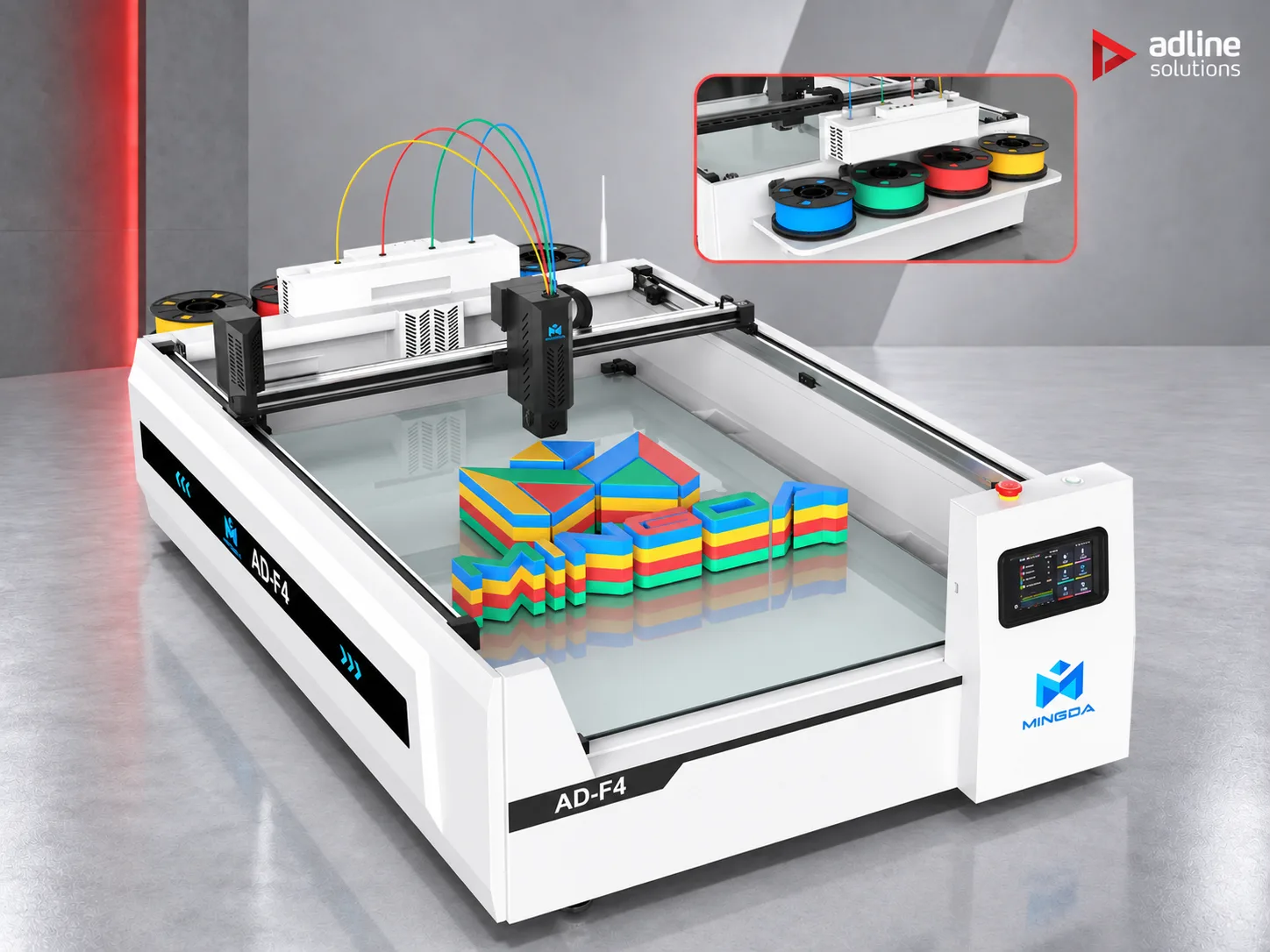
IMS four-colour feeding
Four spools loaded. The colour changes itself.
Four 1 kg spools stay connected to a 4-in-1-out hotend. When a layer calls for the next colour, a cutter inside the head trims the filament, retracts it and pulls in the new one. The nozzle then wipes on a cleaning pad, so the line between two bands stays clean.
- A status light on every channelGreen when the filament is loaded, red when it is missing, with a separate unload button per channel.
- Single-spool modeFor one-colour jobs the IMS can be switched off and the printer feeds from an external spool.
- AdPETG, the filament we supplyWe run and recommend AdPETG on the AD-F4, so the printer and the material come from one supplier. PLA, other PETG and PDS for outdoor signage also run on it.
- Hotend up to 350 °CWith a 0.6 mm nozzle as standard or a 0.8 mm nozzle for large letters.
Klipper firmware · Input Shaper
Fast on the straights, clean on the side wall.
Klipper plans every move ahead, so the head reaches full speed in 0.035 seconds. Fast printing normally shows up as ringing on the vertical faces, which is exactly the surface a passer-by sees on a lit letter. Input Shaper cancels that vibration, so the walls stay clean at production speed.
500mm/s travel speed
- 150 mm/s
- Maximum print speed, 0.6 mm nozzle
- 120 mm/s
- Recommended print speed, 0.6 mm nozzle
- 10,000 mm/s²
- Peak acceleration
Nozzle choice · 0.6 or 0.8 mm
One nozzle for detail, one for volume.
The nozzle sets the width of every line the printer lays down. That decides how fine the letter can be and how quickly its walls build up. We supply the AD-F4 with the 0.6 mm nozzle as standard and the 0.8 mm nozzle as the alternative for large work.
| 0.6 mm · standard | 0.8 mm | |
|---|---|---|
| Line width | About 0.6 mm | About 0.8 mm |
| Wall from two lines | 1.2 mm | 1.6 mm |
| Corners and fine strokes | Sharper corners, narrow strokes and small serifs come out cleanly | Slightly rounder corners; suited to bold, simple shapes |
| Surface of the return | Finer layer lines, smoother wall | Lines more visible, still even |
| Speed | Up to 150 mm/s, 120 mm/s recommended | More material per pass, so large letters finish sooner |
| Strength | Rigid enough for indoor letters and logos | Thicker, stiffer shells for large and outdoor letters |
| Choose it for | Indoor letters, logos with fine detail, most everyday jobs | Large letters, deep returns and light boxes, where volume matters more than fine detail |
Our rule of thumb: start with 0.6 mm, and move to 0.8 mm when the letters are large and the job is about volume rather than fine detail. Layer height stays in the same 0.2 – 0.42 mm range with both, and wall thickness is always set as a multiple of the nozzle width, so the software adapts the walls when you switch.
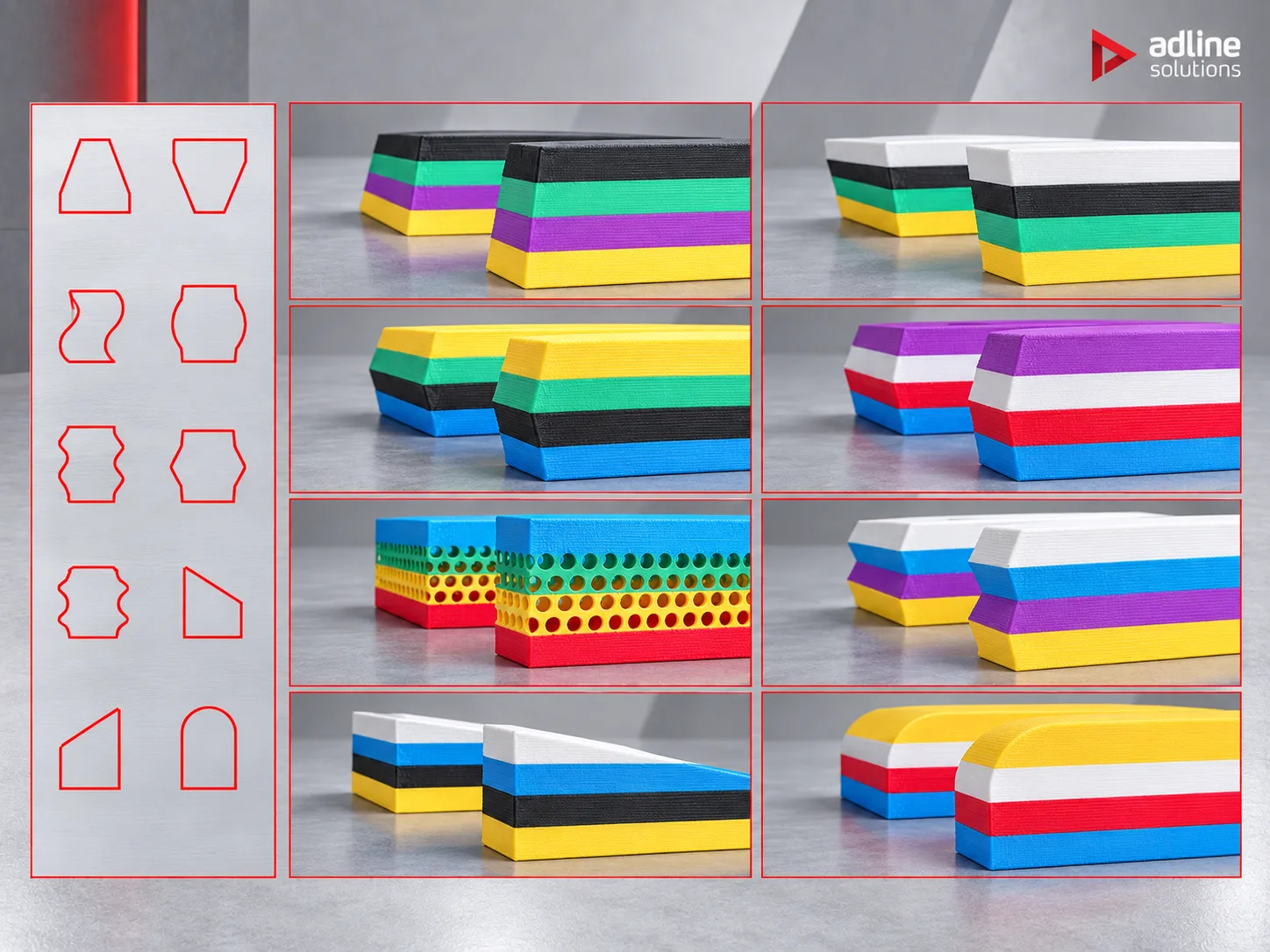
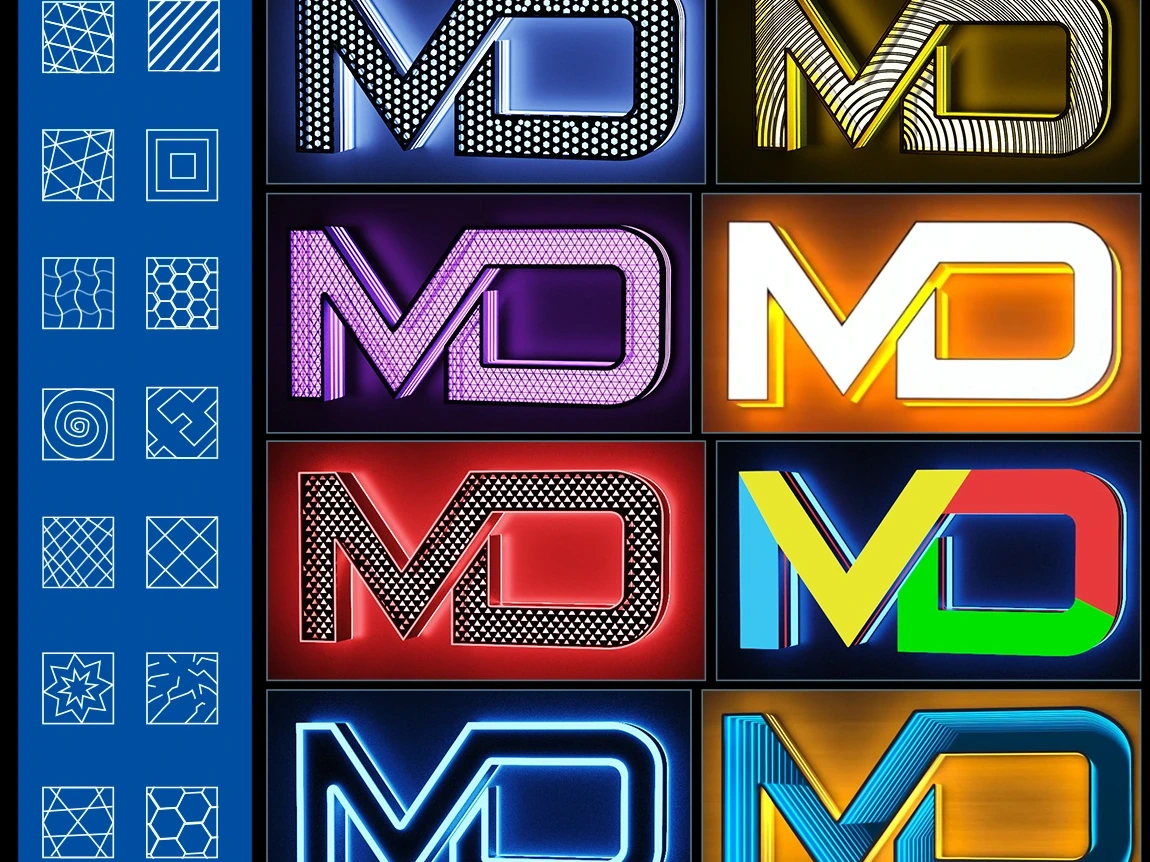
Side profiles · face patterns
You choose the edge of the letter.
The profile and the face are chosen in software, not built by hand. Ten edge profiles cover the usual sign shapes: straight, chamfered, concave, wave, sloped and rounded. Each band on the return can take its own colour, and the face another.
- Perforated wallA return with rows of round openings, for lighter letters and light coming through the side.
- Walls sized to the nozzleWall thickness is set as a multiple of the nozzle diameter, so every wall prints as full, even lines.
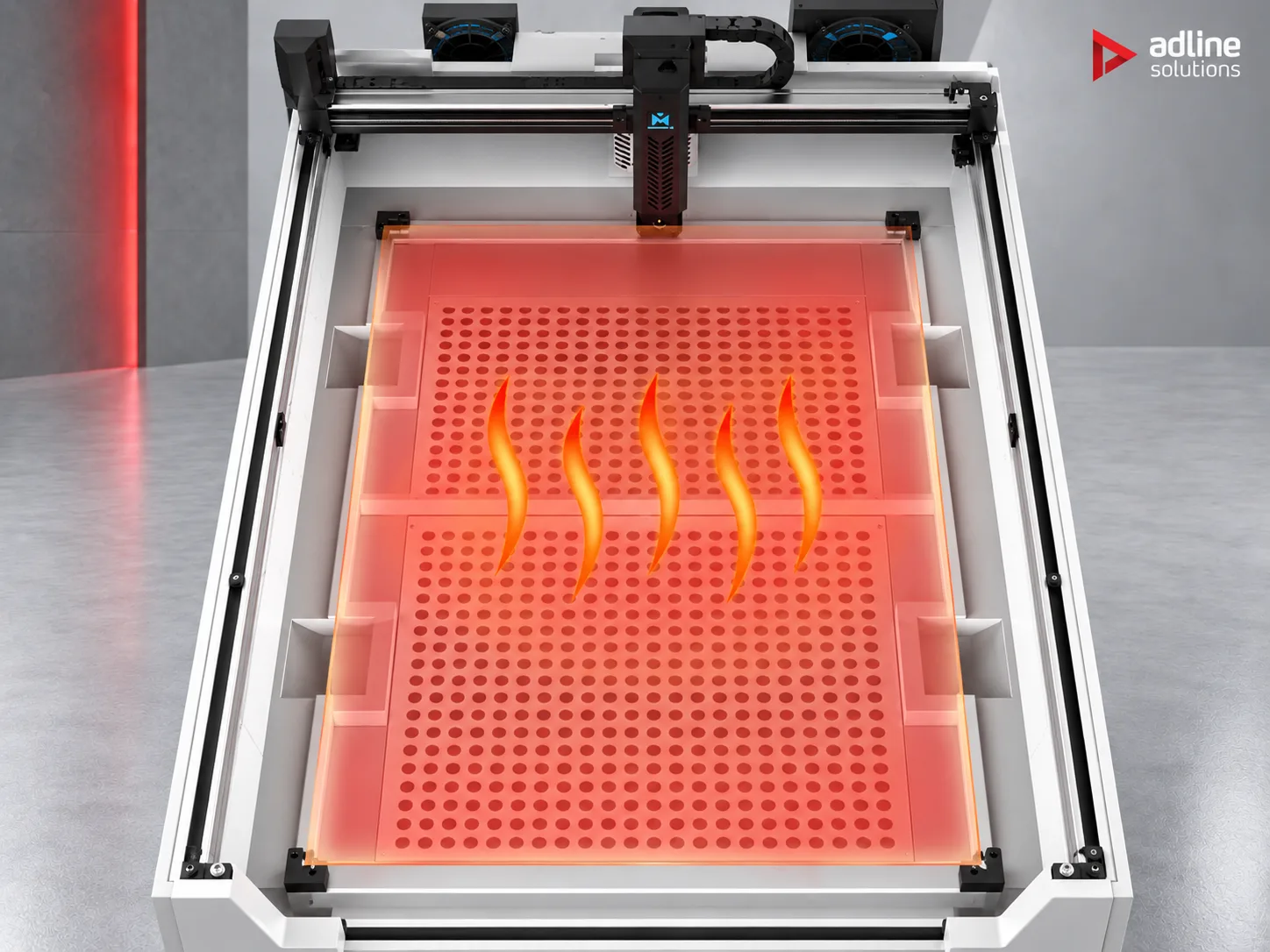
Air-heated bed
The first layer holds across the whole bed.
60°C
The bed is heated by air rather than a conventional mat. It comes up to temperature faster, uses less energy and holds the print flatter, with less warping at the ends of long shells. The platform is tempered glass.
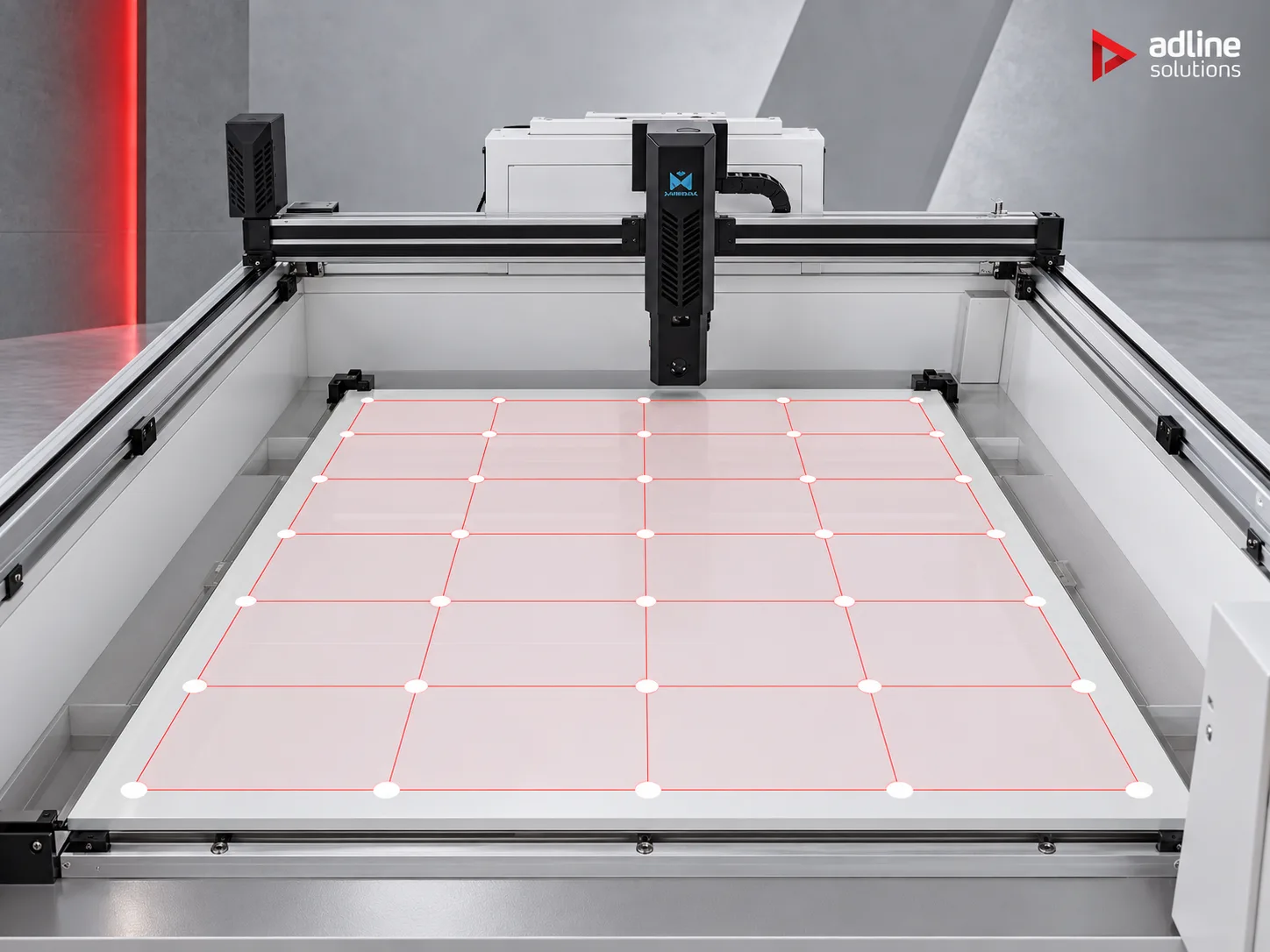
Third-generation auto-levelling
The bed measures itself before every print.
On a 1.2 m bed the first layer is where jobs are lost. The gravity-sensing probe measures a grid of points across the platform and corrects the nozzle height as the first layer goes down, which matters most on letters that span the full 1200 mm.
Points probed: 35 / 35
MINGDA SignMaker software
From outline to finished letter, in one program.
MINGDA's software reads .dxf and .svg directly and builds the walls, face and back of the letter for you, so a sign shop works from the files it already has.
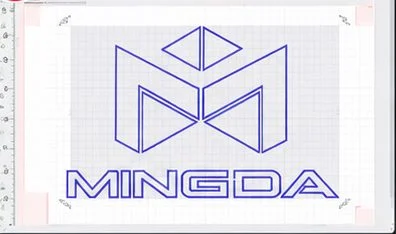
1Import the outline
DXF or SVG, straight from your design software.
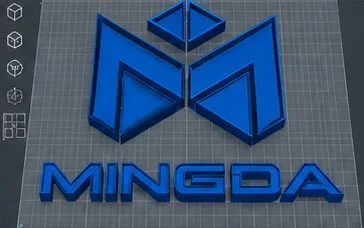
2Build the 3D letter
Set the height, the edge profile and the wall thickness.
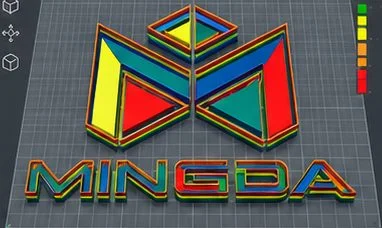
3Assign the colours
Each height band takes one of the four channels.
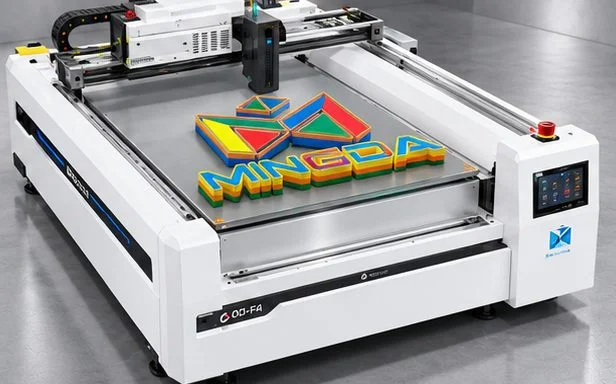
4Print
Send the job over Wi-Fi, Ethernet or USB and lift off a finished, coloured letter.
MINGDA SignMaker runs with the USB licence key supplied with the printer, on Windows and macOS. The back-plate clip and the mirrored outline are set in the same program.
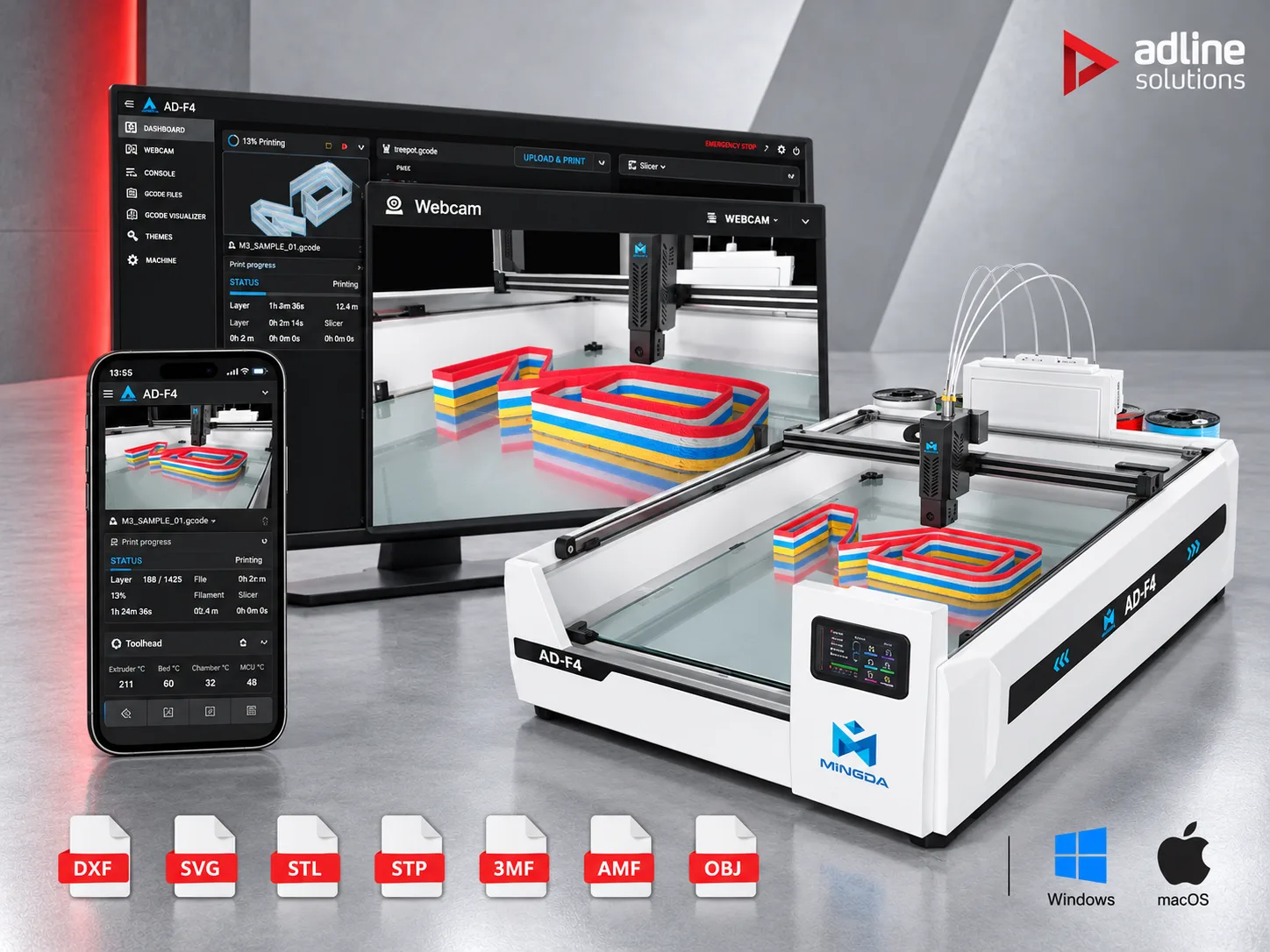
Built-in camera · web panel
Check the overnight run from your phone.
A camera inside the printer streams to the web panel, next to layer progress, temperatures and estimated time. Jobs go out over LAN or WAN, and a shop with several printers switches between them in one device list. On the machine itself there is a 7-inch touchscreen.
Unattended production
The job carries on when a spool runs out.
Filament detection stops the job rather than printing air. The status light turns yellow, the printer waits for the new spool and resumes where it stopped. After a power cut, the print restarts from the layer it was on, which is worth having on a bed that runs for eight hours.
On the floor
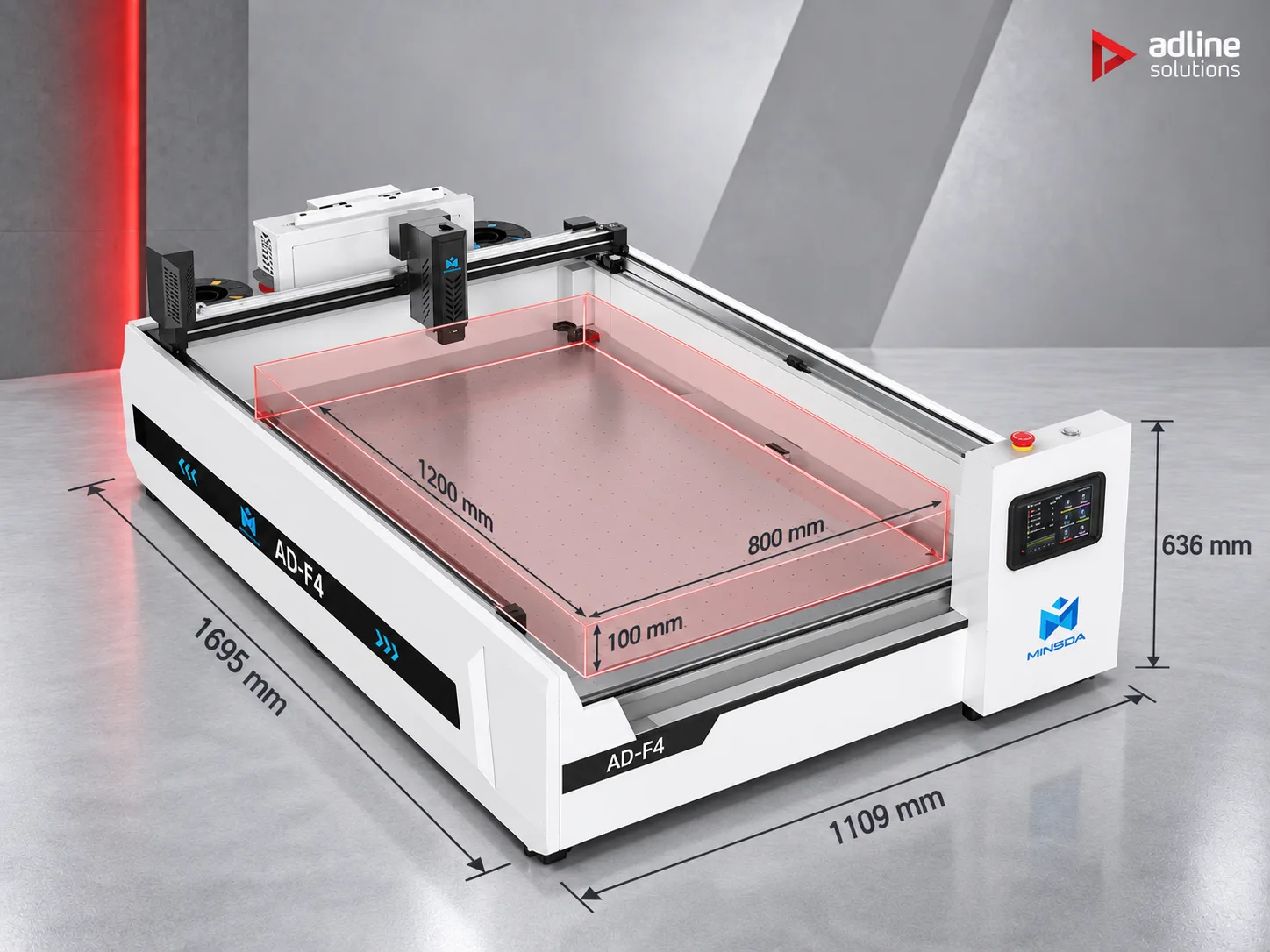
A big bed on a workbench footprint.
The machine measures 1695 × 1109 × 636 mm and runs on 220 V, drawing up to 2,700 W. It ships in a 181 × 121 × 85 cm crate at 285.5 kg gross. A three-colour status light, an emergency stop and an air switch are built in; the machine carries CE and FCC marking.
Need a smaller machine? The AD-F4 Mini brings the same four-colour IMS feeding to a compact frame.
Before installation
Give it a calm corner, not a draughty one.
A large-format FDM printer builds each letter from hundreds of thin layers of warm plastic. Every layer has to cool at the same rate as the one below it. On a 1.2 m bed with 1.2 mm walls, moving air or a cold room cools one side of a long letter faster than the other, and that is where corners lift, walls warp and layers split. Where the machine stands matters as much as how it is set up.
- A steady room temperatureKeep the room at normal workshop temperature all year, roughly 18 – 28 °C, without big swings between day and night or between weekdays and weekends. The nozzle temperature control is calibrated to the room it works in, and auto-levelling is done with the glass bed heated to 60 °C for 20 minutes, so a stable room keeps both accurate.
- No draughtsKeep it away from doors that open often, loading bays, windows, air-conditioning outlets, heaters and fans. A cold draught across the bed is the most common cause of warped and cracked letters on large printers.
- No direct sunlightSun through a window heats one side of the bed and the glass unevenly through the day.
- Dry filamentPETG and PLA take up moisture from the air, which shows up as bubbles, stringing and weak layers. Keep spare spools sealed, avoid damp rooms, and for long or continuous production use a dry cabinet such as the MINGDA MD-F01.
- A solid, level floorThe machine weighs close to 300 kg with its crate and must not stand on a floor that vibrates from presses, compressors or traffic. Vibration shows up directly on the walls of the letter.
- Clean air and its own power lineDust settling on the glass bed spoils first-layer adhesion. Run the printer on its own 220 V circuit rather than sharing it with compressors or heaters, and keep the room ventilated.
Open-plan workshop?
Add an enclosure.
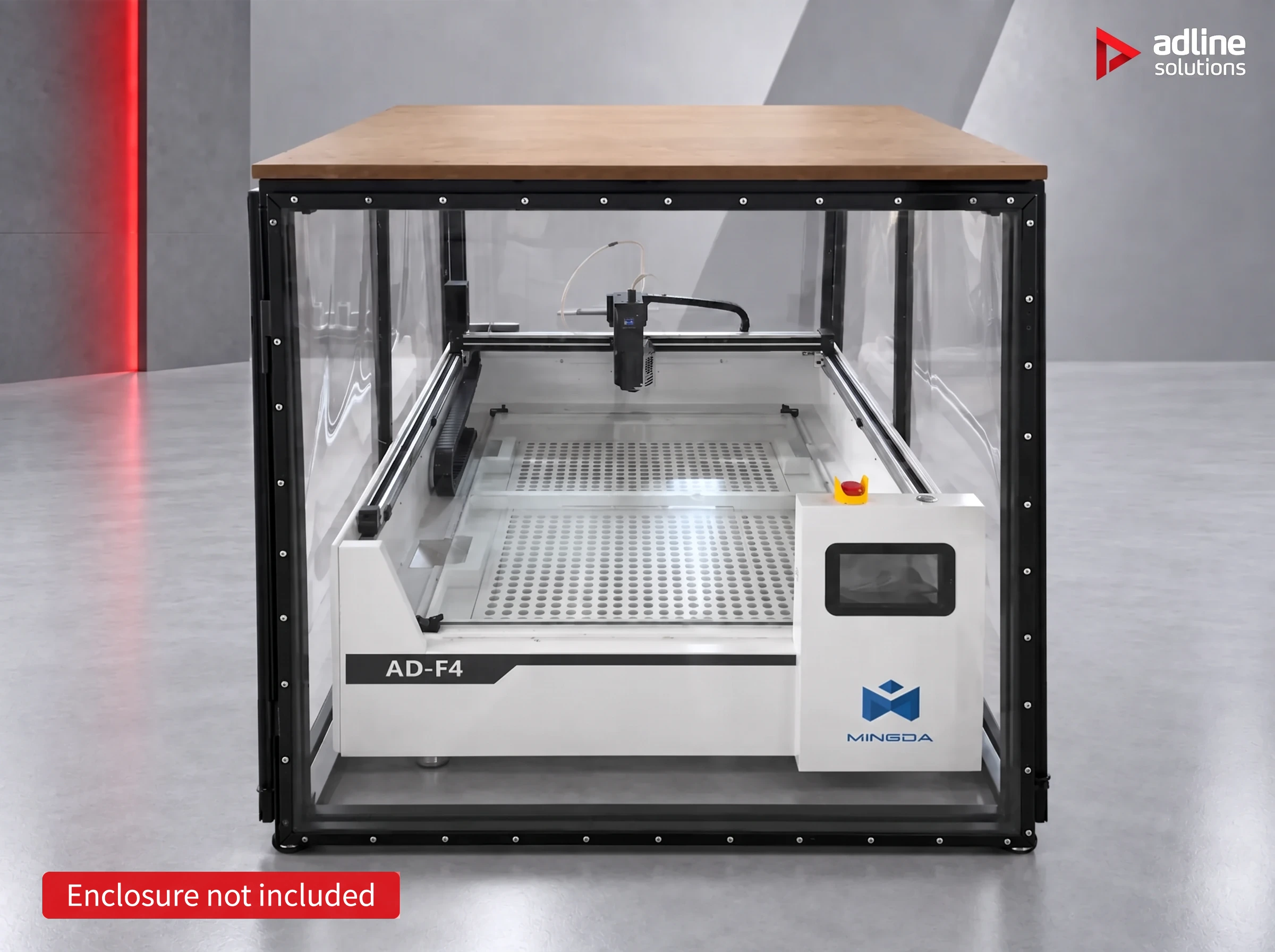
If the printer shares a hall with other machines, doors and people walking past, we recommend placing it inside an enclosure: an aluminium-profile frame with clear side panels and a solid top. It keeps the air around the bed still and warmer, holds the temperature steady through the night and keeps dust off the glass.
The enclosure is not included. You can have one built locally or build it yourselves; leave room to reach the touchscreen, the spool tray and the emergency stop, and to lift finished letters off the bed. Ask us and we will send the machine's dimensions and clearances for the design.
Real job, filmed in our showroom
How much filament does a letter use?
We filmed a full table of 60 mm deep letters printing on the AD-F4 and published the slicer data: 1,292 g of filament and 25 h 05 min for 600 × 960 mm. See what a 50 cm letter needs, and calculate your own text.
The material, explained
Why AdPETG and not ASA?
The AD-F4 prints AdPETG Tough, a filament MINGDA formulated for channel letters. Sign makers ask why not ASA, and whether dark letters hold up in summer sun. We answer with the data-sheet figures, a comparison with PLA, PETG, ABS, ASA and PC, and our design rules for outdoor letters.
Before you order
Tell us what you make.
Tell us the letter sizes and quantities you produce and we will tell you the print time, which nozzle fits the job and what the AD-F4 costs delivered to you.
Technical specifications
Printing
- Technical Principle
- FFF (Fused Filament Fabrication)
- Printing Size
- 1200 × 800 × 100 mm
- Layer Height
- 0.2 – 0.42 mm
- Printing Nozzle
- 4 in 1 out (IMS four-colour feeding system)
- Number of Trays
- 4 (max 1 kg each)
- Nozzle Diameter
- 0.6 mm (standard) or 0.8 mm
- Filament Diameter
- 1.75 mm
- Material Types
- PDS (outdoor signage filament), PLA, PETG
Temperature & climate
- Max Nozzle Temperature
- 350 °C
- Max Hot Bed Temperature
- 60 °C
- Heated Bed
- Air heating bed – faster heat-up, lower energy use, less warping
Speed
- Print Speed (0.6 mm nozzle)
- Max 150 mm/s (recommended 120 mm/s)
- Travel Speed
- Max XY 500 mm/s · Max Z 15 mm/s
- Peak Acceleration
- 10,000 (0 – 300 mm/s in 0.035 s) mm/s²
- Max Flow
- 40 mm³/s
Electrical & control
- Maximum Power
- 220 V / 2,700 W
- Data Connection
- USB drive, Wi-Fi
- Operation Screen
- 7-inch touchscreen
Safety & certification
- Safety Design
- Three-colour warning light, emergency-stop switch, air switch
- Certifications
- CE, FCC
Software
- Firmware
- Klipper (Input Shaper vibration compensation)
- Slicing Software
- MINGDA SignMaker, MINGDA Slicer – font generation, vector reading, 2D-to-3D conversion
- Supported File Types
- .dxf .svg .stl .stp .3mf .amf .obj
- Operating Systems
- Windows / macOS
Functions
- Intelligent Design
- Filament break detection, power-off resume printing
- Remote Management
- Remote monitoring and control over WAN / LAN, with webcam
- Cooling System
- Air-cooled
Mechanics
- Leveling Method
- Third-generation gravity-sensing auto-levelling
- Printing Platform
- Tempered glass platform
Dimensions & weight
- Machine Dimensions
- 1695 × 1109 × 636 mm
- Package Dimensions
- 181 × 121 × 85 cm
- Package Weight
- 285.5 kg
Specifications, images and descriptions are provided for general guidance and may change without notice. Configurations, performance figures and supplied items can vary by production batch and market. The binding specification, scope of supply and terms are those set out in the written quotation we issue for your order.
Application details
Recommended for
Sign makers producing LED channel letters in volume; advertising companies needing four-colour letters without manual filament changes.
Series
AD Series
Frequently asked questions
What can the AD-F4 print?
Channel letter shells, logos and light boxes with walls up to 100 mm deep, on a 1200 × 800 mm bed. A full bed of letters prints in one job, with up to four colour bands on the return and a different colour on the face.
Which filaments does it use?
We run and recommend AdPETG, the PETG filament we supply, so the printer and the material come from one supplier. The AD-F4 also prints other 1.75 mm PETG, PLA and PDS, the filament developed for outdoor signage, from four 1 kg spools loaded in the IMS feeder. The hotend reaches 350 °C and the bed 60 °C.
How long does a typical job take?
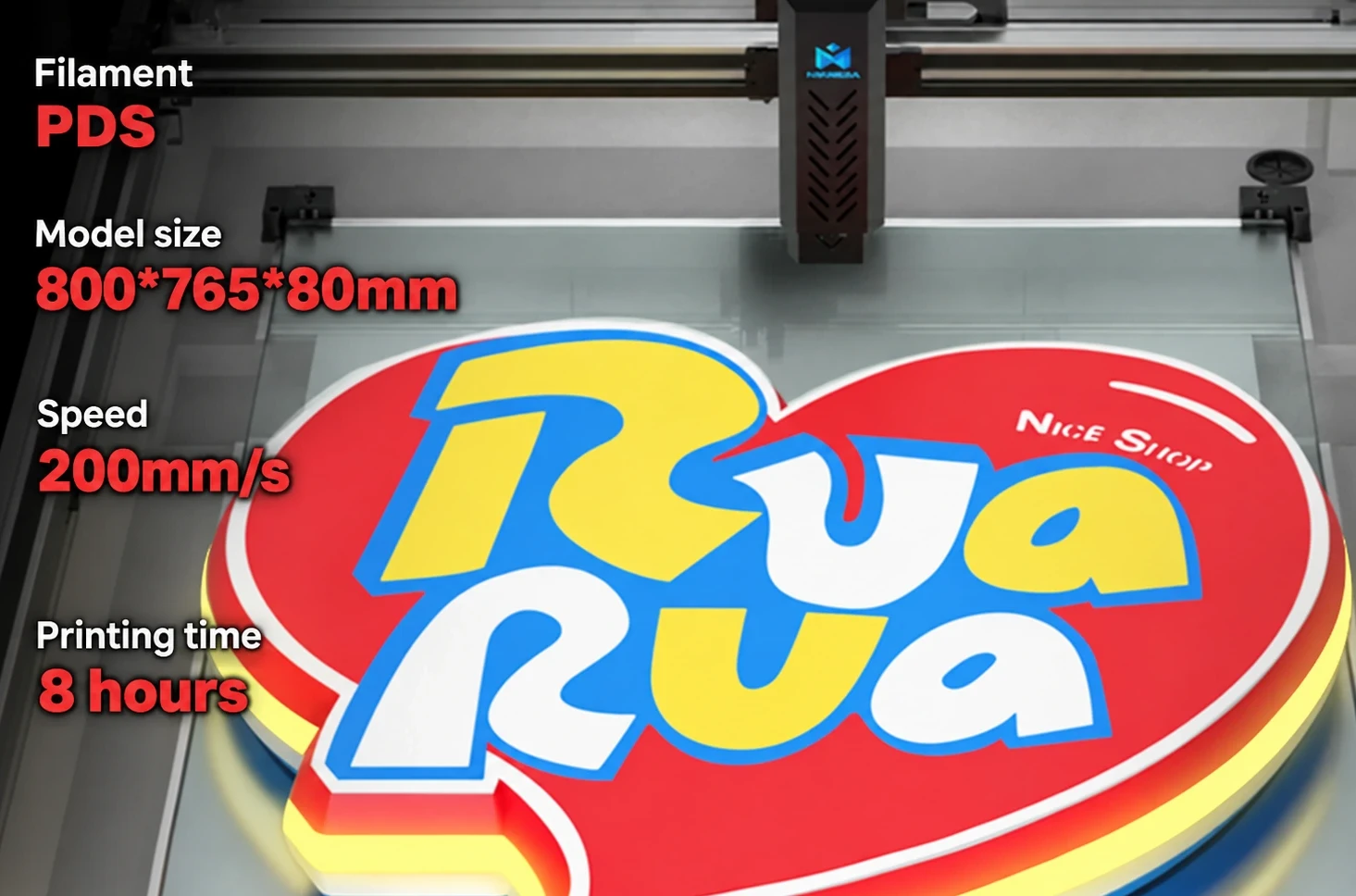
It depends on the size of the letters, the wall thickness and the nozzle. MINGDA's own reference job, an 800 × 765 × 80 mm light box in PDS, takes about 8 hours at 200 mm/s. Tell us the size of your letters and we will estimate the print time before you order.
Which nozzle should we use?
Two sizes, and we supply both for the AD-F4. The 0.6 mm nozzle is standard: sharper corners, finer strokes and smoother walls, at up to 150 mm/s (120 mm/s recommended). The 0.8 mm nozzle lays down wider lines, so large letters, deep returns and light boxes finish sooner and come out with stiffer walls. Wall thickness is set as a multiple of the nozzle width, for example 1.2 mm with the 0.6 mm nozzle and 1.6 mm with the 0.8 mm nozzle.
What software and files does it work with?
MINGDA SignMaker, which runs on Windows and macOS with the USB licence key supplied with the printer. It opens .dxf and .svg artwork, turns the outline into a 3D letter with walls, face and back, assigns the colour bands and slices the job. It also reads .stl, .stp, .3mf, .amf and .obj files.
Can it run overnight without an operator?
Yes. Filament detection stops the job instead of printing air when a spool runs out; the status light turns yellow and the print resumes where it stopped once a new spool is loaded. After a power cut it restarts from the last layer. The built-in camera and the web panel let you check progress from a computer or a phone, over Wi-Fi or Ethernet.
Do we also need the MD-C02?
Only if you make resin-filled letters. The AD-F4 prints finished letter shells that go straight to assembly with LEDs and a face. If you also want epoxy-filled letters, the printed shells are filled with resin and cured in the MD-C02 UV curing machine; one bed of letters from the AD-F4 matches one MD-C02 curing cycle.
What do we need on site?
A 220 V supply rated for up to 2,700 W, ideally on its own circuit, and a solid, level floor for a machine of 1695 × 1109 × 636 mm. It ships in a 181 × 121 × 85 cm crate at 285.5 kg gross, so plan for a forklift or a pallet truck at delivery. Choose a spot with a steady room temperature, away from doors, windows, air-conditioning and heaters; in an open-plan workshop we recommend an enclosure around the printer (not included). EU-wide delivery; installation and set-up available on request.