
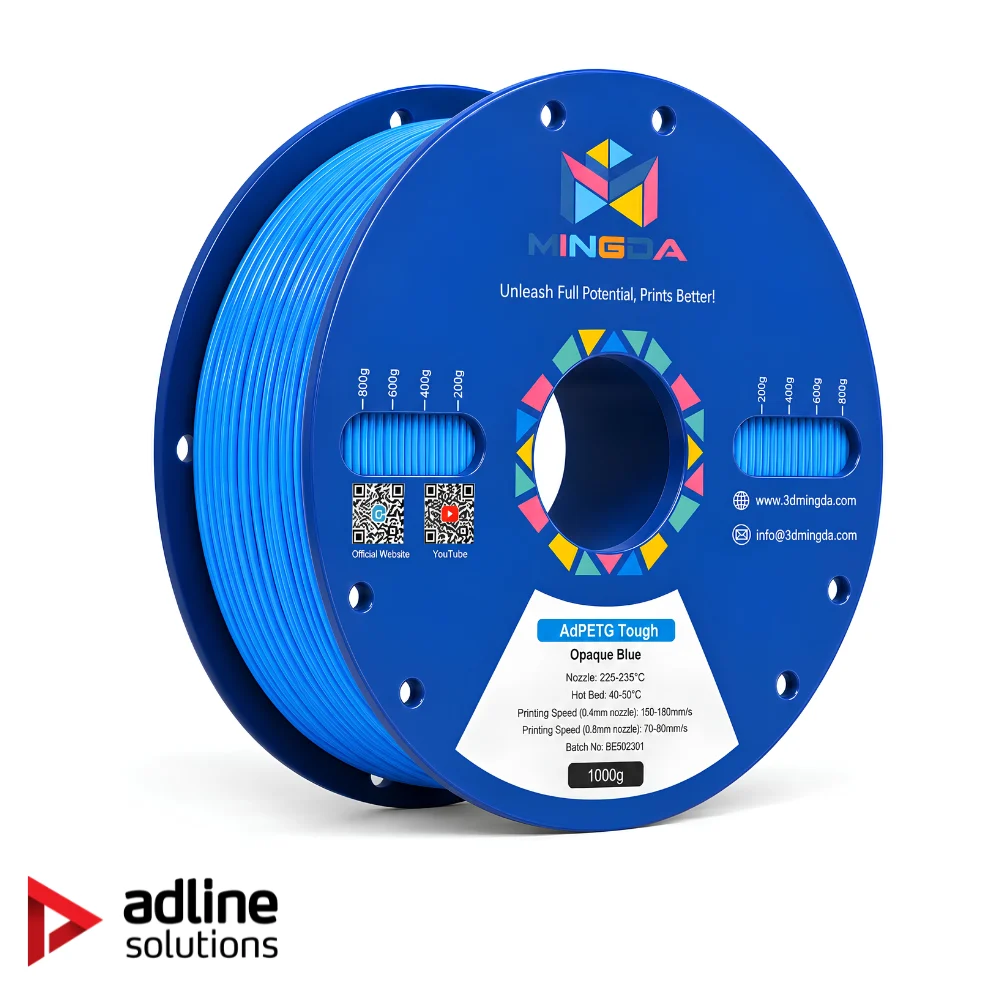
MINGDA AD-F4 · the material
AdPETG vs ASA: which filament for channel letters?
Most sign makers use the AD-F4 for what takes the longest by hand: the return of the letter — the side wall that carries the acrylic face. The printer builds it as one piece, in AdPETG Tough, a filament MINGDA developed only for channel letters. Almost everyone who looks at the machine asks the same question: why not ASA, PLA or another filament they know? This page answers it — with the figures from the manufacturer's data sheet and our recommendations for outdoor letters.
- Elongation
- 120 %
- Impact (Izod)
- 85 J/m
- HDT
- 70 °C
- Bed temp.
- 40–50 °C
The material
What AdPETG Tough is
AdPETG Tough is a modified PETG, formulated by MINGDA for what a printed letter return demands: thin walls of 1.2–2.4 mm, parts up to 800 × 1200 mm, fast printing, a clean surface that needs no finishing, and years outdoors. It comes in two grades, in 24 colours; the four-filament system of the AD-F4 can combine them in the same print:
Light-blocking the everyday grade
For returns and backs — the part most customers print. Densely pigmented, so no light bleeds through the wall even at 1.5 mm; the acrylic face is glued on as on a conventional letter.
Light-transmitting
For fully printed letters — face and return in one piece, usually unlit — where the translucent colours give a glass-like depth, and for light boxes: 90 % light transmission with under 1 % haze.
| Property | Method | Value |
|---|---|---|
| Density | ASTM D1505 | 1.27 g/cm³ |
| Shrinkage | ASTM D955 | 0.2–0.5 % |
| Tensile strength (yield) | ASTM D638 | 50 MPa |
| Elongation at break | ASTM D638 | 120 % |
| Flexural strength | ASTM D790 | 71 MPa |
| Flexural modulus | ASTM D790 | 2,150 MPa |
| Izod impact, notched, 23 °C | ASTM D256 | 85 J/m |
| Heat deflection temperature, 0.455 MPa | ASTM D648 | 70 °C |
| Heat deflection temperature, 1.82 MPa | ASTM D648 | 62 °C |
| Water absorption, 24 h | ASTM D570 | 0.13 % |
| Light transmittance (light-transmitting grade) | ASTM D1003 | 90 % |
| Haze (light-transmitting grade) | ASTM D1003 | < 1 % |
| Nozzle temperature | spool label | 225–235 °C |
| Bed temperature | spool label | 40–50 °C |
| Print speed, 0.8 mm nozzle | spool label | 70–80 mm/s |
| Print speed, 0.6 mm nozzle | MINGDA | 80–100 mm/s |
| Part cooling fan | MINGDA | on |
Side by side
Compared with PLA, PETG, ABS, ASA and PC
No material wins on every line. For a printed return, what matters is — in this order — whether it can be printed at all at letter size (bed, chamber, shrinkage), impact resistance, UV stability, heat resistance and, for fully printed letters or light boxes, the look of the translucent grade. AdPETG Tough values are from the MINGDA data sheet; the other columns are typical catalogue values and vary by brand.
Tensile strength
- AdPETG Tough
- 50 MPa
- PLA
- 55–65 MPa
- PETG
- 45–50 MPa
- ABS
- 40–45 MPa
- ASA
- 40–45 MPa
- PC
- 60–70 MPa
Elongation at break
- AdPETG Tough
- 120 %
- PLA
- 5–8 %
- PETG
- 10–25 %
- ABS
- 10–30 %
- ASA
- 15–30 %
- PC
- 80–120 %
Izod impact, notched
- AdPETG Tough
- 85 J/m
- PLA
- 20–30 J/m
- PETG
- 50–70 J/m
- ABS
- 150–250 J/m
- ASA
- 100–150 J/m
- PC
- 600+ J/m
HDT, 0.455 MPa
- AdPETG Tough
- 70 °C
- PLA
- 55–60 °C
- PETG
- 70–75 °C
- ABS
- 95–100 °C
- ASA
- 95–100 °C
- PC
- 130–140 °C
UV stability outdoors
- AdPETG Tough
- good
- PLA
- poor
- PETG
- good
- ABS
- poor, yellows
- ASA
- very good
- PC
- fair, yellows
Translucent grade (fully printed letters, light boxes)
- AdPETG Tough
- 90 %, haze < 1 %
- PLA
- milky
- PETG
- fair
- ABS
- opaque
- ASA
- opaque
- PC
- clear, no diffusion
Shrinkage on cooling
- AdPETG Tough
- 0.2–0.5 %
- PLA
- 0.3 %
- PETG
- 0.3–0.6 %
- ABS
- 0.8–1.5 %
- ASA
- 0.7–1.2 %
- PC
- 0.6–0.8 %
Bed temperature needed
- AdPETG Tough
- 40–50 °C
- PLA
- 50–60 °C
- PETG
- 70–80 °C
- ABS
- 95–110 °C
- ASA
- 90–110 °C
- PC
- 100–120 °C
Heated chamber needed
- AdPETG Tough
- PLA
- PETG
- ABS
- ASA
- PC
Fumes while printing
- AdPETG Tough
- negligible
- PLA
- negligible
- PETG
- negligible
- ABS
- styrene
- ASA
- styrene
- PC
- low
Prints on the AD-F4
- AdPETG Tough
- PLA
- PETG
- ABS
- ASA
- PC
Reading the table for letters: ASA, ABS and PC win on heat, but none of them can be printed at letter size and speed without a heated chamber — and a return is a large, thin-walled part, the hardest shape for a material that shrinks. PLA prints easily but softens from 55 °C and degrades under UV, so it does not last outdoors. AdPETG Tough is the only material in the table that combines printability on large thin parts, toughness and UV stability — plus a translucent grade for fully printed letters — in one filament.
Questions sign makers ask
The questions we get before an order
1Why doesn't the AD-F4 print ASA?
Because ASA and a channel letter have incompatible requirements — not because of a limit in the printer. ASA shrinks 0.7–1.2 % as it cools, so it has to be kept warm for the whole print: a bed at 90–110 °C and an actively heated chamber, so the layers cool slowly and evenly. An 800 × 1200 mm letter with 1–2 mm walls cannot be printed like that on any letter printer on the market.
| On a letter printer | ASA | AdPETG Tough |
|---|---|---|
| Bed at 40–60 °C | Corners lift off the bed in the first layers; large letters come loose. | Stable adhesion — the material is formulated for 40–50 °C. |
| No heated chamber | Internal stress; cracks between layers on tall returns. | Layers bond evenly; no cracking. |
| Part cooling fan on (needed at 80–180 mm/s) | Weak layer bonding, delamination. | Fast cooling improves the surface finish. |
| 8–40 h of continuous printing | Styrene fumes — needs extraction. | No significant emissions. |
MINGDA does build printers for ASA, ABS and polycarbonate (the Raptor series, with a heated chamber), but they are technical machines with a much smaller build volume at several times the price. For letters the answer was a dedicated material, not adapting the machine to ASA. Opacity is not the issue — a return is opaque whatever it is made of; the issue is that ASA cannot be printed as a 1.5 mm wall a metre long without the heat it needs.
2Do the letters deform outdoors — in summer heat or in frost?
Under normal mounting conditions, no. The heat deflection temperature (HDT) of AdPETG Tough is 70 °C at low load (0.455 MPa). A dark letter in direct summer sun can reach 60–70 °C at the surface; a light-coloured one stays 15–25 °C cooler. For dark colours the numbers are close, so the question is a fair one — but it matters what HDT measures.
HDT is the temperature at which a test bar bends by a set amount under a continuous load. A channel letter is not a load-bearing part: the only load it carries is its own weight, spread over the whole mounting surface. Near HDT the material does not lose its shape — it becomes slightly less rigid, and a visible deformation needs a sustained load a letter fixed to a façade does not have.
The real risk case — and, as an illustration, the hardest one to manage outdoors in summer — is the combination of a dark colour, a large flat face, south-facing exposure and LEDs that give off a lot of heat inside the letter. For those projects we recommend what 3D-letter producers across Europe already do:
- a clear varnish with UV filter on dark returns — it cuts heat absorption and protects the colour;
- low-power LEDs and enough letter depth for air to move;
- on very large flat faces, internal ribs generated in the slicer, which add stiffness without visible material.
For light colours, partly shaded façades, interiors, shop windows and totems, AdPETG Tough needs no extra precautions.
In frost there is no deformation risk, and AdPETG Tough keeps its toughness at sub-zero temperatures — unlike PLA and ABS, which turn brittle and can crack in freezing weather or when knocked in the cold season. Daily freeze–thaw cycles do not affect it, thanks to its very low shrinkage and water absorption.
For comparison: ASA has an HDT of about 95 °C, so a larger thermal margin. PLA has an HDT of 55–60 °C and softens visibly on a sunny façade, which is why we do not recommend it outdoors.
3Why not PLA, if it is cheaper and easy to print?
PLA suits indoor letters, prototypes and colour samples, but not outdoor use. Three reasons:
- Heat: HDT of 55–60 °C. A PLA letter on a sunny façade softens and warps in its first summer.
- UV: PLA degrades in sunlight — it turns brittle, fades and cracks after one or two seasons.
- Moisture: PLA is biodegradable in warm, humid conditions; outdoors it ages fast.
PLA remains a good option for indoor letters and exhibitions, where price and colour range matter more than durability. The AD-F4 prints PLA without any changes.
4Why not an ordinary PETG off the shelf?
Generic PETG prints on the AD-F4 and has similar base properties, but AdPETG Tough was formulated for letters, with differences that show in production:
- Toughness: elongation at break of 120 % against 10–25 % for generic PETG — the letter takes knocks and handling without cracking.
- Guaranteed opacity in the light-blocking grade, even with thin walls — coloured generic PETG often lets light bleed through the return, which shows as a glowing halo at night.
- Controlled optics for fully printed letters and light boxes: the light-transmitting grade is evenly translucent (haze under 1 %) at 90 % transmission. A clear PETG from the shelf is glassy and shows every LED as a hot spot; a white one is milky and dull.
- Low bed temperature (40–50 °C instead of 70–80 °C): less energy and stable adhesion over the whole 800 × 1200 mm bed.
- Consistency between batches and across the 24 colours — essential when many letters for one sign are printed over weeks.
- Declared for outdoor use by the manufacturer, without yellowing in long-term use.
5Does it yellow or fade in the sun?
PETG is, by its chemistry, far more UV-stable than PLA or ABS, and MINGDA declares AdPETG Tough for long-term outdoor use without yellowing in both grades. For a signage application the difference from ASA — the reference material for UV stability — is small.
As with any material in the sun, saturated colours (red, orange) fade sooner than neutral ones, whatever the polymer. For projects with a long-term colour promise we recommend a clear varnish with UV filter, which also reduces the heating of the return.
For comparison: ABS yellows and turns brittle within one or two years outdoors; PLA fades and cracks; unprotected polycarbonate yellows visibly.
6How does it stand up to knocks, hail and wind?
AdPETG Tough is tougher than ASA and PLA: 120 % elongation at break and a notched Izod impact strength of 85 J/m. In practice the letter flexes slightly and recovers instead of shattering — in hail, from accidental knocks during installation or from objects carried by the wind. ASA (100–150 J/m) absorbs impact well but, being stiffer, cracks rather than flexing under repeated loads; PLA (20–30 J/m) shatters.
In wind, the structure of the return matters more than the material: a printed return is one continuous contour, with no bent corners, rivets or welds for the wind to work loose over time, as on a return bent from aluminium coil.
7What about rain, humidity and freezing?
AdPETG Tough absorbs very little water (0.13 % after 24 h of immersion, per the TDS) and does not degrade in damp conditions — PETG is the material bottles and food packaging are made from for exactly this property. In freezing weather it keeps its toughness, unlike ABS and PLA, which turn brittle below zero.
One point to note: humidity matters before printing, not after. The filament ships vacuum-sealed with desiccant; an opened spool must be kept dry (a box with silica gel or a filament dryer), otherwise bubbles and strings appear in the letter walls. This is the rule for any PETG, and we recommend it to every customer.
8Can it be painted, varnished or glued?
Yes. AdPETG Tough takes the usual finishing products for plastics:
- Varnish: a clear acrylic or polyurethane varnish with UV filter, after degreasing with isopropyl alcohol. Recommended on dark returns exposed to the sun.
- Paint: plastic primer, then acrylic or polyurethane paint. With 24 colours available from the spool, painting is rarely needed.
- Glue: cyanoacrylate for small joints, epoxy or MS-polymer structural adhesives for mounting. Solvent welding is possible but less effective than on acrylic.
- Mechanical fixing: the material drills and taps without cracking, thanks to its toughness.
9Can I use filament from other brands on the AD-F4?
Yes. The printer takes any 1.75 mm filament from the PLA, PETG and PDS families, with the nozzle up to 300 °C and the bed up to 80 °C — there is no brand lock. Materials that need a bed above 80 °C or a heated chamber (ABS, ASA, PC, nylon) cannot be printed correctly at letter size, whatever the brand.
We recommend AdPETG Tough for production for the reasons above — optics, toughness and batch consistency — and because the print profiles in the MINGDA slicer are calibrated for it. For colour tests or indoor projects, PLA or PETG from other brands works, with the slicer settings adjusted.
In short
Design rules for outdoor letters
| Situation | Our recommendation |
|---|---|
| Indoor letters, shop windows, exhibitions | AdPETG Tough or PLA; no special precautions. |
| Outdoors, light colours or a partly shaded façade | AdPETG Tough; no special precautions. |
| Outdoors, black or dark returns, south-facing | AdPETG Tough light-blocking + clear UV varnish on the returns; low-power LEDs; enough depth for air to move. |
| Very large flat faces (over 600 mm) | Internal ribs from the slicer; walls of at least 1.5 mm. |
| Saturated colours with a long-term colour promise | Clear UV varnish. |
| Technical parts exposed to more than 80 °C (not letters) | Not an AD-F4 application — needs a printer with a heated chamber (ASA, PC). |
| Filament storage | Sealed until use; once opened, a dry box with silica gel or a filament dryer. |
How the letter is built with the AD-F4
From stock
AdPETG colours we keep in stock
1.75 mm filament on 1 kg spools, vacuum-sealed with desiccant. Opaque for returns and backs, translucent for fully printed (usually unlit) letters and light boxes — both grades can print on the same job, from the same spool tray. Screen colours are approximate; we send physical samples on request.
Opaque (light-blocking) · 8 colours
For returns and backs — the part most customers print.
- Red
- Yellow
- Green
- Blue
- White-grey
- Silver
- Grey
- Black
Translucent (light-transmitting) · 17 colours
For fully printed letters, light boxes and backlit panels.
- Red
- Orange
- Mandarin orange
- Yellow
- Gold
- Green
- Mint green
- Light blue
- Blue
- Purple
- Pink
- Bronze
- Transparent
- White
- Silver
- Grey
- Black
How much does a letter cost in filament?
We filmed a real job on the AD-F4 and published the slicer data. See what a 50 cm letter needs and calculate your own text.