
PURE-AIR PA-FS1600i Fume & Dust Extractor
On request
- 1600 m³/h airflow
- Up to 10000 Pa negative pressure
- HEPA H14 filtration, 99.99% @ 0.3 µm
- Activated carbon stage for VOC and odour
- PIPS intelligent control
Intelligent fume extraction unit, 1600 m³/h at up to 10000 Pa. Acrylic, paper and card, leather, textiles, technical plastics. PIPS intelligent control.
Request a quoteWhich model fits your machine? Read the guide- 3D printing / AM
- Acrylic & plastics
- CNC routing
- Laser cutting
- Laser engraving
- Textiles & leather
About this machine
PA-FS1600i · Intelligent fume extractor
Smoke out of the cut, clean air back into the room.
The PA-FS1600i pulls 1,600 m³/h at up to 10,000 Pa straight from the laser or router, takes the smoke, fine dust and odour out in three stages, and returns the air to the workshop. It is sized for CO₂ lasers with a bed of about 100 × 160 cm, CNC routers cutting acrylic and plastics, and 3D printers.
The i stands for PIPS, PURE-AIR's intelligent control: it shows the real airflow, watches every filter stage and raises the fan speed as the filters load, so extraction stays the same from a new filter to the day it is due for a change.
- 1,600 m³/h
- Airflow
- 10,000 Pa
- Maximum negative pressure
- 99.997%
- H14 filtration at 0.3 µm
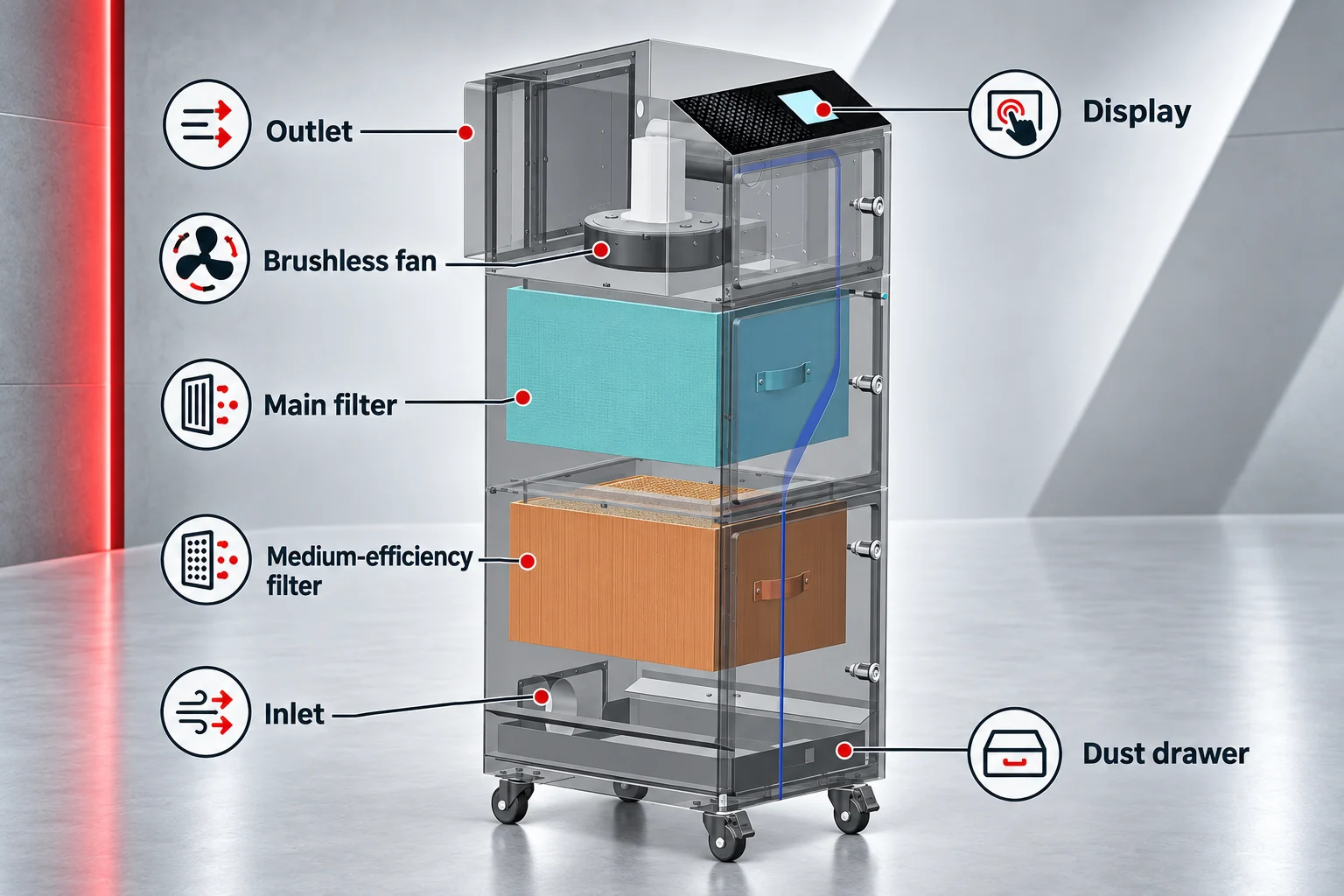
Three-stage filtration
What happens between the laser and the room.
The air enters at the bottom and rises through the filters, coarsest first, so each stage only sees what the one before it let through.
- Inlet · 150 mmSmoke and dust from the machine come in through a short duct. Heavy particles drop into the dust drawer underneath.
- F9 deep-pleat pre-filterStops 95% of particles down to 0.9 µm, on 12 – 30 m² of pleated media depending on the model.
- H14 main filter + activated carbonThe H14 stage holds 99.997% at 0.3 µm, the hardest size to catch. Behind it, 12 – 30 kg of treated activated carbon take out odour and solvent vapour.
- Brushless fanAbove the filters, so it only ever moves clean air.
- OutletThe filtered air goes straight back into the workshop. No outside duct is needed.
The filters slide out from the front; PURE-AIR quotes about a minute for a change. Cutting wood, plywood or MDF? Choose the FGS series instead: resinous wood smoke blinds an F9 pre-filter in a fraction of its normal life.
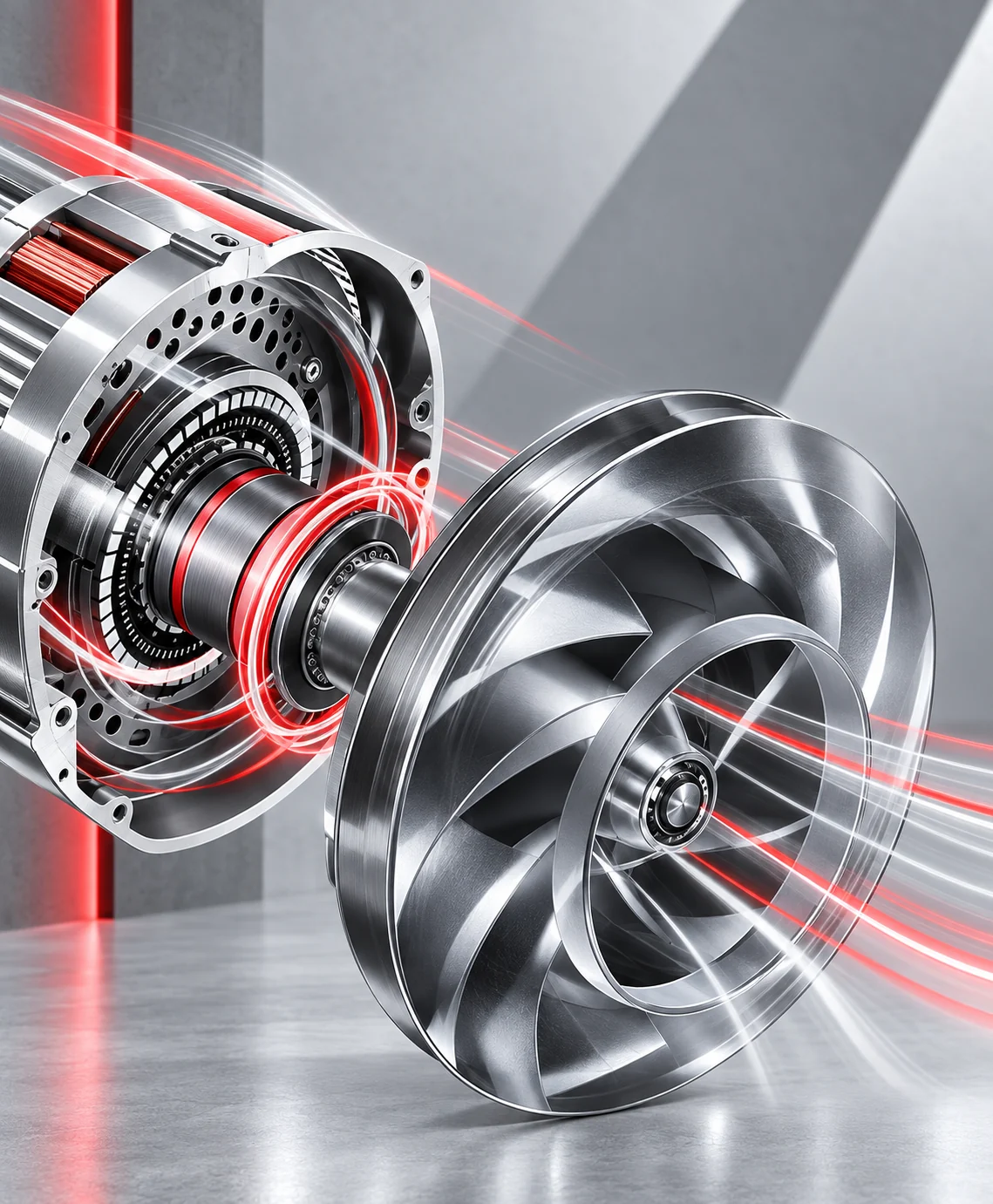
Brushless high-pressure fan
Suction where the smoke is made, not just in the cabinet.
Airflow alone does not clear a laser. The air has to be pulled through the machine, the duct and three filters, and every one of them pushes back. The PA-FS1600i's brushless fan builds up to 10,000 Pa of negative pressure, enough to keep drawing smoke out of the cutting zone through a real duct run and a filter that is no longer new.
A brushless motor has no brushes to wear out. PURE-AIR rates the fan for 30,000 hours without maintenance and quotes about 25% lower energy consumption for this fan design.
PIPS intelligent control
Real numbers on the screen, not a dial.
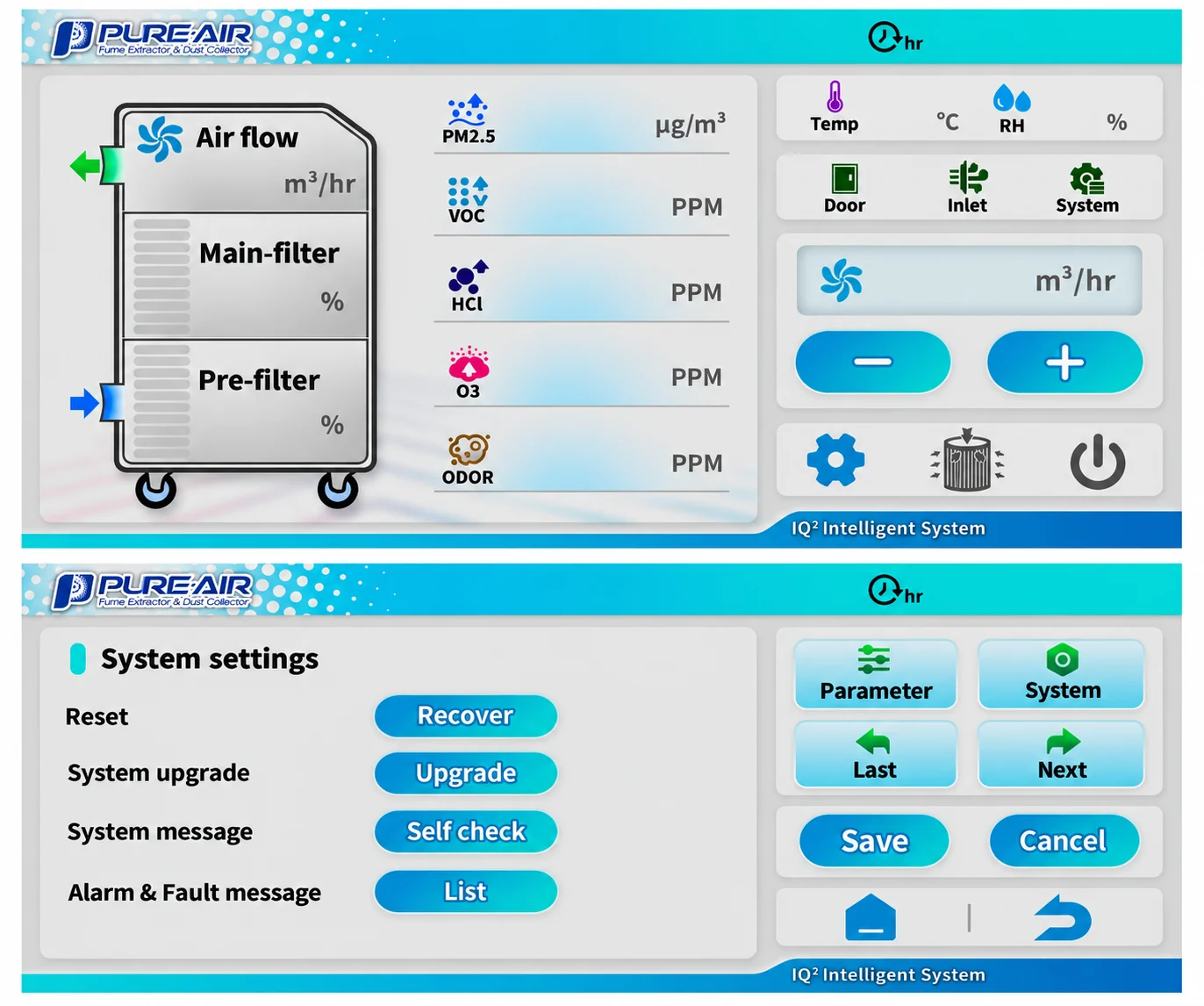
- Live airflow and pressureMeasured by sensors, in m³/h, rather than a fan speed setting that says nothing about what actually reaches the laser.
- Filter health, stage by stageThe pre-filter and the main filter each show how loaded they are, with a warning before they block, so a change is planned instead of forced.
- Connects to the machineI/O and RS-485 for starting and stopping with the laser, remote control, and several units run together from one point.
- Air-quality sensors, optionalPM2.5, VOC, O₃ and other readings on the same screen, when you need to show what leaves the outlet.
- Firmware updates from a TF cardNew functions are loaded on site, without sending the unit back.
Automatic airflow compensation
As the filter loads, the airflow doesn't drop.
Every filter gets harder to breathe through as it collects dust. On a conventional extractor the fan runs at the same speed, so the airflow quietly falls and smoke starts escaping from the laser long before the filter looks full.
PIPS measures the real airflow and raises the fan speed to keep it at the set value, all the way to the point where the filter is due for a change. Then it tells you.
Illustration of the principle; the values are indicative.
Built-in safety
It checks itself before it starts.
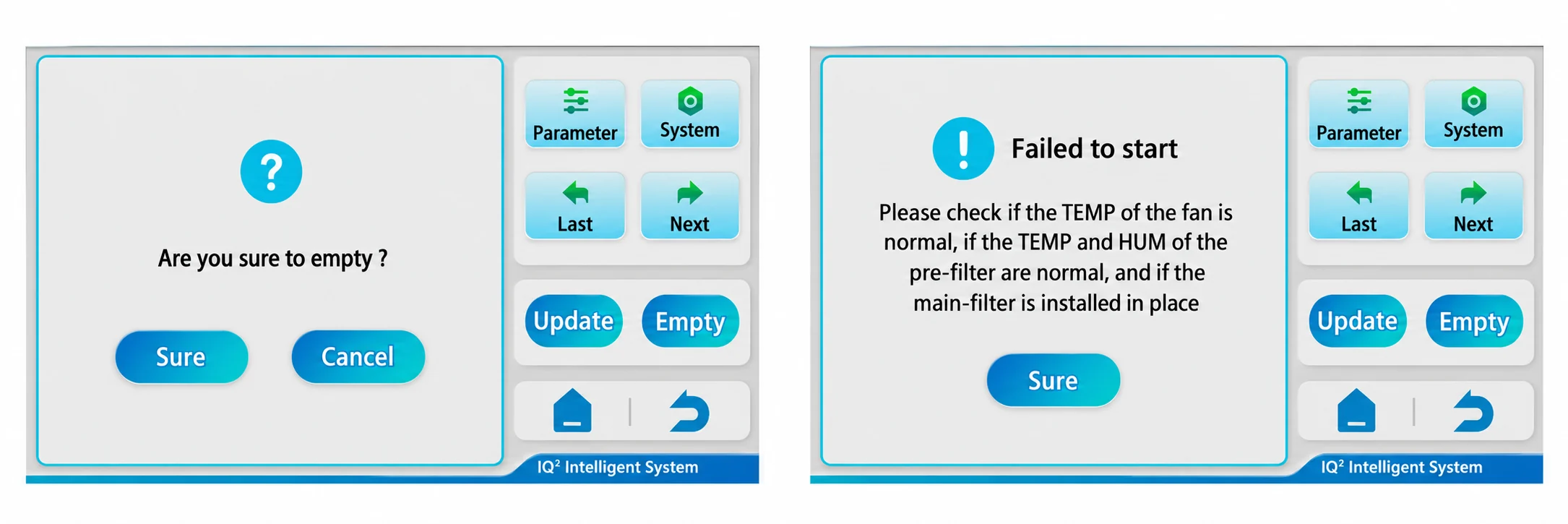
Before it runs, the unit checks the fan temperature, the temperature and humidity at the pre-filter and whether the main filter is in place. If temperature or humidity go out of range during work, it shuts down on its own: hot sparks or damp air in a loaded filter are how filters get damaged and fires start. A missing filter means no start at all, so unfiltered air never reaches the fan or the room.
Who builds it
One maker, one platform, across the range.
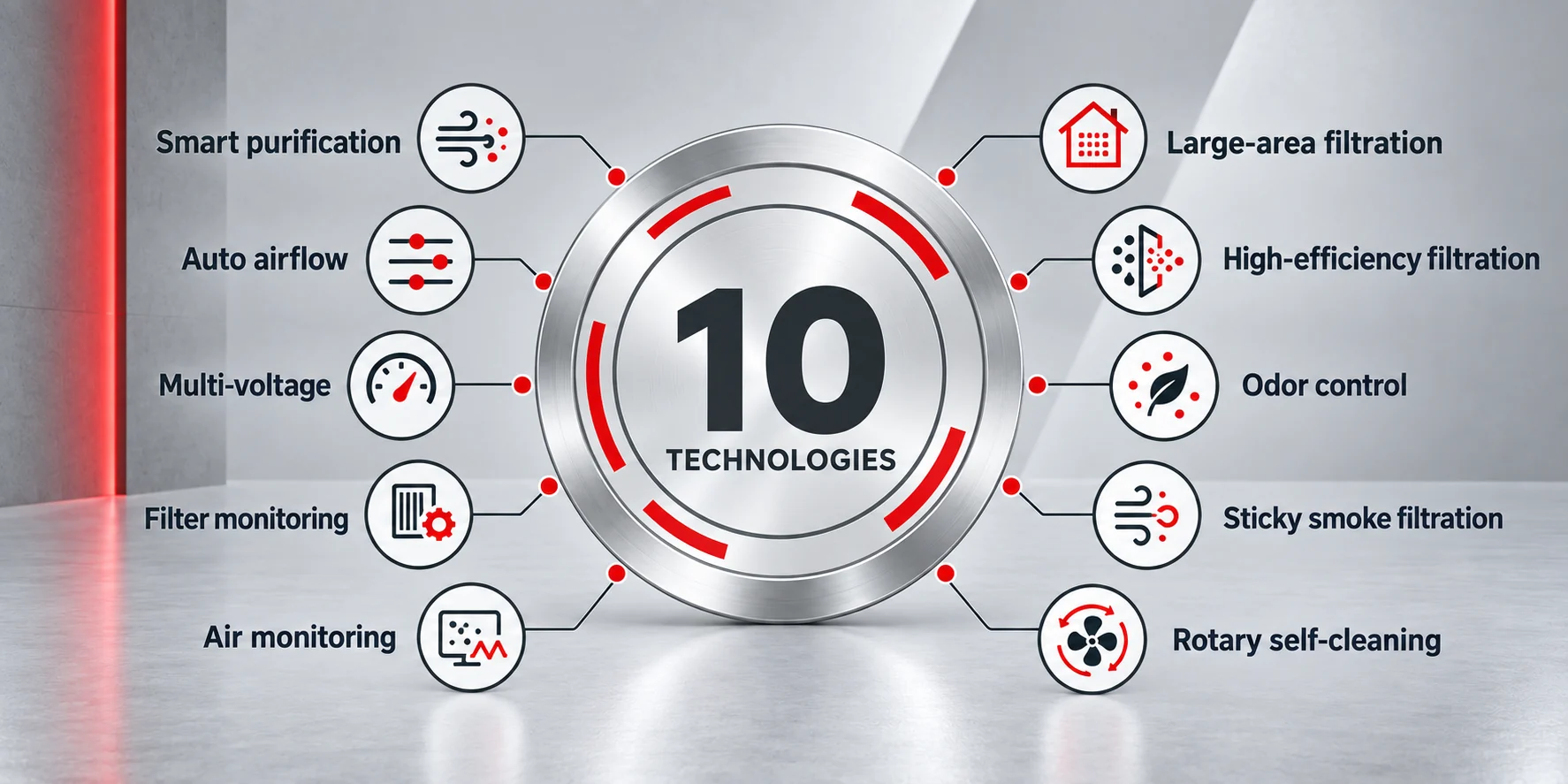
PURE-AIR builds fume and dust extractors for laser, electronics, 3D-printing and inkjet production and develops its core technology in-house. Not every technology applies to every series: on the FS-i you get the smart purification and automatic airflow control, filter and air monitoring, the multi-voltage power stage, large-area high-efficiency filtration and odour control. The sticky-smoke and rotary self-cleaning systems belong to other series.
Choose the size
Size it by the machine, not by the room.
The extractor has to pull enough air through the laser's own exhaust, so the bed size and the number of machines on one unit decide the model. The typical laser bed below is a starting point; long ducts, several machines or heavy smoke call for the next size up.
| Model | Airflow | Pressure | Power | Noise at 1 m | Inlet | Typical laser bed |
|---|---|---|---|---|---|---|
| PA-FS400i | 400 m³/h | 8,000 Pa | 1.0 kW | < 60 dB(A) | 75 / 100 mm | 40 × 60 cm |
| PA-FS500i | 500 m³/h | 10,000 Pa | 1.1 kW | < 60 dB(A) | 75 / 100 mm | 80 × 100 cm |
| PA-FS800i | 800 m³/h | 10,000 Pa | 1.3 kW | < 63 dB(A) | 100 / 125 mm | 90 × 130 cm |
| PA-FS1600i | 1,600 m³/h | 10,000 Pa | 2.3 kW | < 65 dB(A) | 150 mm | 100 × 160 cm |
| PA-FS2400i | 2,400 m³/h | 10,000 Pa | 3.5 kW | < 68 dB(A) | 200 mm | 130 × 250 cm |
If your bed is smaller, the PA-FS800i is enough; for a larger bed or two machines on one unit, the PA-FS2400i.
Installation
Next to the machine, on a normal socket.
- Single-phase power2.3 kW rated, on 210 – 257 V or 90 – 110 V, 50/60 Hz. The power stage tolerates normal grid fluctuation; where the supply varies by more than ±10%, add a voltage stabiliser.
- Short, straight ductingConnect the machine's exhaust to the 150 mm inlet with flexible duct kept as short and straight as possible. Every extra metre and every bend costs suction.
- Room to breathe and to serviceLeave about 150 mm free at the outlet and keep the front accessible: all filters are changed from the front.
- Built for the workshop floor185 kg in powder-coated mild steel or brushed stainless steel, compact enough to stand beside the machine it serves.
Before you order
Tell us the machine and the material.
Send us the machine, its working area, the materials you cut and how many hours a day it runs. We will confirm the right model and filters and send you an offer for the PA-FS1600i.
- Clean air out · brushless fanpulls through every stage
- Stage 3 · activated carbonholds VOC and odour
- Stage 2 · HEPA H1499.99% @ 0.3 µm
- Stage 1 · F9 pre-filterholds coarse dust
- Contaminated air inducted from the machine; dust drawer emptied from the front
Technical specifications
- Phase
- Single-phase
- Airflow
- 1600 m³/h
- Inlet size
- 150 mm
- Net weight
- 185 kg
- Pre-filter
- F9 deep-pleat pre-filter, 95% @ 0.9 µm, 12-30 m² of media
- Main filter
- H14 deep-pleat filter, 99.997% @ 0.3 µm
- Noise level
- 65 dB(A) max.
- Rated power
- 2.3 kW
- Power supply
- 90-110 V / 210-257 V, 1 ph, 50/60 Hz
- Control system
- PIPS intelligent control
- Explosion-proof
- No
- Activated carbon
- Yes - treated activated carbon, approx. 12-30 kg
- Cabinet construction
- Powder coated mild steel / brushed stainless steel
- Dimensions (W×D×H)
- 670 x 769 x 1356 mm
- Max. negative pressure
- 10000 Pa
Specifications, images and descriptions are provided for general guidance and may change without notice. Configurations, performance figures and supplied items can vary by production batch and market. The binding specification, scope of supply and terms are those set out in the written quotation we issue for your order.
Application details
Recommended for
CO₂ laser cutters and engravers with a bed of 100x160 cm; CNC routers cutting acrylic, composites and plastics; Resin, SLA, DLP and FFF 3D printers
Materials
Acrylic, paper and card, leather, textiles, technical plastics; resin-based 3D printing
Typical working format
100x160 cm
Control system
PIPS - Pure-Air Intelligent Purification System. Industrial touch screen, real-time airflow and negative-pressure readout, filter health manager with early replacement warning, automatic airflow compensation as the filter loads, I/O and RS-485 for MES / robot / multi-unit linkage, optional PM2.5 / VOC / O3 sensors, temperature and humidity safety shutdown, TF-card firmware upgrade.
Installation
Free-standing on castors next to the machine. Connect the machine's exhaust port to the inlet with flexible ducting kept as short and straight as possible - every extra bend costs suction. Allow 150 mm clearance at the outlet and keep the front accessible: all filter stages are changed from the front. Filtered air is discharged back into the room, so no outside duct is needed.
Series
FS
Frequently asked questions
Which machines is the PA-FS1600i for?
CO₂ laser cutters and engravers with a working area of about 100 × 160 cm, CNC routers cutting acrylic, composites and plastics, and resin and FFF 3D printers. It moves 1,600 m³/h at up to 10,000 Pa. For several machines on one unit, long duct runs or heavy smoke, choose the next size up, or send us your setup and we will size it.
Can it be used for wood, plywood or MDF?
We do not recommend it. Wood smoke is resinous and sticky and clogs the F9 pre-filter far sooner than acrylic or plastics do. For wood, plywood and MDF choose the PURE-AIR FGS series, which is built for that smoke.
What does the "i" version add?
PIPS, PURE-AIR's intelligent control: a touch screen with the real airflow and negative pressure, filter status for each stage with an early replacement warning, automatic airflow compensation as the filters load, I/O and RS-485 for linking to the machine and to other units, optional PM2.5 / VOC / O₃ sensors, a temperature and humidity safety shutdown, and firmware updates from a TF card.
How long do the filters last, and how do we know when to change them?
It depends on the material, the hours and the amount of smoke, so there is no fixed interval. The screen shows how loaded each stage is and warns before a filter blocks. The F9 and H14 filters cannot be washed: cleaning destroys the filter structure. Replace them with original filters, which slide out from the front.
Does it need to be ducted outside?
No. The filtered air is returned to the room after the H14 stage and the activated carbon, so the unit only needs a duct from the machine to its inlet. Leave about 150 mm free at the outlet.
What power supply does it need?
Single-phase 210 – 257 V or 90 – 110 V, 50/60 Hz, with a rated power of 2.3 kW. It runs normally with grid fluctuations of up to ±10%; beyond that we recommend a voltage stabiliser.
Can it start and stop with the laser?
Yes. I/O lets the laser start and stop the extractor, and RS-485 allows remote control and several units to be run together from one point, which suits workshops with more than one machine.
When is an explosion-proof extractor needed instead?
When the machine processes flammable metals such as aluminium, magnesium or titanium alloys, or when flammable gases are present in the workshop. The FS-i is not explosion-proof; for those cases ask us for an explosion-proof model.